














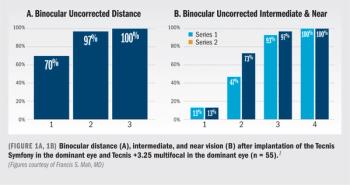
EDOF, multifocal IOLs providing options for patients with range of visual needs

EDOF, multifocal IOLs providing options for patients with range of visual needs

Retina specialist Ron M. Kurtz, MD, details the way collaborative innovation can improve the lives of ophthalmic surgeons, and their patients.

Approach enables patients to maintain best possible vision with one-time only procedure

Microinstrumentation provides surgeons increased control

Shan C. Lin, MD, provides the key takeaways from his presentation at the annual Glaucoma 360 meeting.
Several points to consider before you make the leap

Lens fragmentation device eases difficult cases from phaco to small-incision extracapsular techniques

A JAMA Ophthalmology study investigates late surgeon career stage cataract outcomes
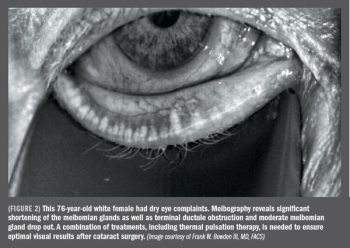
Start ocular surface treatment 6 weeks prior to cataract surgery for best outcomes

Charity seeks to raise $US20 million to address avoidable blindness in women, girls

Christopher F. Wood, MD, discusses the importance of learning new technologies to treat floaters

International panel shares overview of current and future applications, benefits, challenges
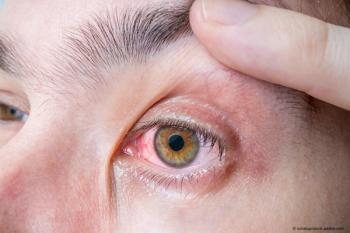
Approach aids toric IOL alignment, IOL centration, wound/astigmatic keratotomy placement

How an unforgettable patient could see-and speak out-again


Ophthalmology Times’ Editorial Advisory Board members share their thoughts on what to watch in year ahead


WFG LASIK achieved better 25% contrast acuity gains in corrected/uncorrected distance VA

Doug Katsev, MD, discusses the findings from a study concerning atopic dermatitis and cataract development for the Medical News Minute.


Are older individuals less likely to undergo cataract surgery if they have small support groups? A retrospective cohort study of Medicare patients published in JAMA Ophthalmology looked at this question.

Findings from a pilot study show that a novel accommodative intraocular lens (AIOL, Lumina, Akkolens) provides a true accommodative response that is maintained for at least 2 years and preserved following Nd:YAG laser capsulotomy.

A micro-interventional device that uses a nitinol filament can dissect any grade cataract without causing capsular stress.
Concerns over the ocular surface, compliance, cost, and patient callbacks are lessened when surgeons take a transzonular approach to medication delivery during cataract surgery.
Intracameral antibiotics used for prophylaxis are a preferred approach during cataract surgery.