
Nadia K. Waheed, MD, MPH; and David M. Brown, MD, discuss barriers to step therapy and the impact of the COVID-19 pandemic on intravitreal injections.

Nadia K. Waheed, MD, MPH; and David M. Brown, MD, discuss barriers to step therapy and the impact of the COVID-19 pandemic on intravitreal injections.
Charles Wykoff, MD, took the stage at the American Society of Retina Specialists annual meeting in New York to present a talk titled “Suprachoroidal Delivery of RGX-314 Gene Therapy for Diabetic Retinopathy: Phase II ALTITUDE Study.” He discusses results of the trial, which showed improvements for patients diagnosed with diabetic macular edema and non-proliferative diabetic retinopathy, with notable improvements according to the Diabetic Retinopathy Severity Scale.
Nadia K. Waheed, MD, MPH; and David M. Brown, MD, review unmet needs and the importance of selecting the proper needle for intravitreal injections.
Experienced ophthalmologists provide advice for opening up high-volume intravitreal injection clinics.
Lloyd Clark, MD, highlights his ASRS presentation focusing on the PANORAMA study detailing the use of aflibercept in the management of diabetic retinopathy.

Ehsan Sadri, MD FACS, A minimally invasive glaucoma surgery specialist discusses impressions and key take away points from patient case.
Ehsan Sadri, MD FACS reviews the case of a 67-year-old white female with open angle glaucoma and how she benefits from minimally invasive glaucoma surgery.
A minimally invasive glaucoma surgery specialist discusses impressions and key take away points from patient case and how minimally invasive glaucoma surgery has changed the landscape of open angle glaucoma.
Nadia K. Waheed, MD, MPH, and David M. Brown, MD, discuss how to accurately and safety monitor a patient post-intravitreal injection.
Expert ophthalmologists discuss the differences between in-clinic intravitreal injections and operating theaters utilizing intravitreal injections.
Ehsan Sadri, MD, FACS, reviews the case of a 58-year-old male with open angle glaucoma utilizing minimally invasive glaucoma surgery procedure.
David Brown, MD, highlights his ASRS poster that includes 44-week data for a four-times-higher dose of aflibercept in a real-world setting.
Rahul Khurana, MD, shares a preview of his ASRS poster based on an analysis of the second year of the VIEW 1 and VIEW 2 studies comparing aflibercept and ranibizumab treatment arms.
Nadia K. Waheed, MD, MPH, and David M. Brown, MD, discuss guidelines available to ensure proper intravitreal injections.
Nadia K. Waheed, MD, MPH, and David M. Brown, MD, discuss how intravitreal injections have changed the treatment landscape of retinal eye disorders.
As ophthalmologists observe Cataract Awareness Month this June, William L. Soscia, MD, medical director at Center for Sight, in Sarasota, Florida, focuses on the importance of having excellent vision for safety and everyday functions.
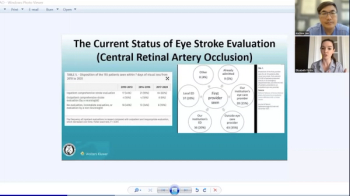
On this week's episode of the NeuroOp Guru, Andy Lee, MD, and Elizabeth Fortin, MD, discuss the current status of eye stroke evaluations for CRAO.

The study assess retinal blood biomarkers using a new prototype OCT, aiming to measure retinal biomarkers such as blood flow volume, average velocity, and vessel diameter with a new prototype.
Carlos Quezada Ruiz, MD, senior medical director at Genentech, discusses “Predicting optimal treatment regimen for patients with neovascular age-related macular degeneration using machine learning.”
As novel therapies in the pipeline are aiming to decrease the rate of GA expansion—the endpoint Karl Csaky, MD and Fredrick Ferris III, MD, identified in 2007—Dr. Csaky reinforces on the importance of preserving the central retinal tissue.
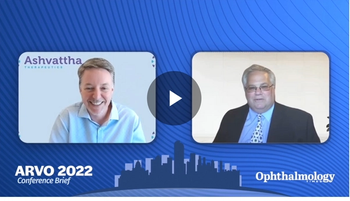
Jeff Cleland, PhD, CEO of Ashvattha, discusses safety data for an at-home subcutaneous injection option being developed for wet AMD and DME. The anti-VEGF candidate will enter a Phase 2 study later this year.
Presented at ARVO 2022, research from Mass Eye and Ear hopes to open a new avenue for therapies that are for helping treat patients that develop primary open angle glaucoma.
The study found that if certain forms of nystagmus that are seen in patients, then there is a higher chance of poor binocular visual function, as well as higher interocular suppression.
The study evaluates three separate cases, each which experiences irreversible changes in their corneal structure caused by challenges in getting timely treatment due to various reasons, including insurance, lost to follow up, and the coronavirus pandemic.

At ARVO 2022 in Denver, Colorado, Timothy Blenkinsop, MD, presented “3D Eye Organoids with Distinct Cornea.” His presentation outlined how these organoids have developed sophisticated cornea structures.
The Phase 3 integrated PEACHTREE and AZALEA study data revealed strong safety and efficacy for triamcinolone acetonide via suprachoirodal injection.
The study's primary endpoints were to look at increasing Schirmer's scores, as well as eye discomfort score.
Catching up after ASCRS 2022, Ora's Caitlin Black, senior director and therapeutic area head of medical devices, talks about the next generation of ophthalmic device therapies and diagnostics, clinical trial updates and new innovations that are most exciting for presbyopia treatment.

Penny Asbell, MD, FACS, MBA, discusses “Antibiotic Resistance among Ocular Staphylococcal Pathogens: Longitudinal Trends in the ARMOR Study."
Takeaway: there doesn't seem to be a specific dry eye phenotype that does better or worse.