
At EURETINA 2026, Jordi Monés, MD, PhD, outlined the rationale for gene-agnostic optogenetic therapy MCO-010 to restore vision in Stargardt disease and geographic atrophy.

At EURETINA 2026, Jordi Monés, MD, PhD, outlined the rationale for gene-agnostic optogenetic therapy MCO-010 to restore vision in Stargardt disease and geographic atrophy.

Real-world VOYAGER data at EURETINA 2026 show vision and anatomic outcomes with faricimab across nAMD, DME, and RVO.

At EURETINA 2026, David Steel reviewed registry evidence on gas and silicone oil tamponades for retinal detachment repair and outlined novel tamponade agents in his Kreissig Award Lecture.
At EURETINA 2026, Roger Goldberg, MD, MBA, explains why EYP-1901 missed LUGANO's primary endpoint despite matched anatomy, clean safety and a 42% cut in treatment burden.
Ritesh Narula, MBBS, MS, discusses phase 1 and early phase 2 results of the Eyestem subretinal stem cell study in geographic atrophy, including an 11-letter mean visual acuity gain maintained at 18 months.
At EURETINA 2026, Arshad Khanani, MD, FASRS, reviews sura-vec, 4D-150 and ixo-vec, 3 nAMD gene therapies in phase 3 with readouts expected over the next 12 months.

Ashish Sharma, MD, on what real-world data show about switching and long-term outcomes with retinal biosimilars.
João Pedro Marques, MD, MSc, PhD, FEBOphth, discusses the IRD-PT, a web-based Portuguese registry of roughly 2,400 patients with inherited retinal diseases that supports research and identifies patients for clinical trials.
At EURETINA 2026, Elon van Dijk, MD, PhD, FEBOphth, reviewed trial evidence favouring half-dose PDT over micropulse laser and eplerenone for central serous chorioretinopathy.

Paul Nderitu, MBChB, MPhil, MBCS, FRCOphth, PhD, gives an update at EURETINA 2026 on Global RETFound, a foundation model being built with 108 partners from more than 40 countries
Katherine Talcott, MD, discusses phase 2 VERONA results showing EYP-1901 plus aflibercept reduced supplemental treatment needs in DME, with early vision and anatomy gains and no significant safety signals.
At EURETINA 2026, Arshad Khanani, MD, FASRS, reviews 2-year SPECTRA data on 4D-150 gene therapy for DMO and the phase 3 4SIGHT trial comparing it with aflibercept.

Serena Salvatore, MD, discusses the retinal laser training gap, persistent laser myths, simulation and practical advice for safer laser at EURETINA 2026.
Ester Carreño, MD, PhD, explains how to tell retinitis pigmentosa from uveitis and why genetic confirmation now matters more.

Women’s systemic and ocular health associated with pregnancy is a focus at EURETINA 2026 in Vienna.
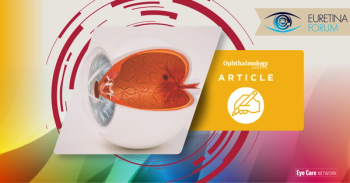
Three EURETINA 2026 e-posters examine OCT/OCTA biomarkers and real-world switching to faricimab or aflibercept 8 mg in nAMD.

Three studies use OCT and OCTA to track AMD treatment response, flag diabetic retinopathy before oedema and confirm ocular toxoplasmosis.

Francesca Cordeiro, PhD, MD, FRCOphth, explains how Detection of Apoptosing Retinal Cells (DARC) imaging predicted the speed and direction of GA growth and could help stratify patients for treatment.

Inherited metabolic diseases affect the retina even before the systemic diagnosis is established.

An industry symposium on intravitreal 4D-150 and a course on subretinal delivery lead gene therapy content at EURETINA 2026, alongside IRD courses and trial readouts.
Cathleen McCabe, MD, presents real-world data from a 57-site US study of the enVista Aspire IOL at ESCRS 2026, reporting over 90% patient satisfaction and 20/32 uncorrected intermediate vision in more than 70% of patients.

Alessandro Arrigo, MD, describes an early-stage method that uses blue light autofluorescence imaging to grade cataracts objectively. He explains why a reproducible score could help with surgeon selection, IOL power calculation, and retinal image quantification.
Three residents were honored for their leadership, education and research, and patient care contributions in ophthalmology, optometry, and retina.

EURETINA President Nicole Eter, MD, picks the sessions busy clinicians should follow at the 26th EURETINA Congress in Vienna, from durability data to AI. She also explains why early referral is still the most effective retina treatment.

At ESCRS 2026, Jascha Wendelstein, MD, noted standard ETDRS visual acuity testing misses functional differences between multifocal IOLs that reading-speed testing reveals.
Helena Noguera Nuñez, MD, discusses a prospective study of the TECNIS Odyssey IOL from ESCRS 2026.

For decades, topical medications have been the default first-line treatment for glaucoma. However, the well-recognized challenges of daily eye drops, including poor adherence, ocular surface disease, fluctuating intraocular pressure (IOP), and long-term treatment, have fueled a significant transformation in glaucoma therapy. As a result, glaucoma management has undergone a fundamental shift towards laser-based solutions.

Samantha Harding, MD, discusses how ultra-widefield imaging reduces dilation needs and improves diagnosis in paediatric eye care.

At WSPOS Subspecialty Day during the 44th Congress of the ESCRS in London, Mark Bullimore, PhD, MCOptom, shared early trial data suggesting the Stellest 2.0 lens may slow myopic progression twice as fast as the original.

Hove stresses surgeons who prescribe premium lenses or laser surgery to patients should be willing to have those same treatments themselves when needed.