
Mark Breazzano, MD, FACS, who is presenting Outcomes and Clinical Features Predictive of Fungal Endophthalmitis at the 2023 ASRS meeting in Seattle, Washington spoke with our team about this research.

Mark Breazzano, MD, FACS, who is presenting Outcomes and Clinical Features Predictive of Fungal Endophthalmitis at the 2023 ASRS meeting in Seattle, Washington spoke with our team about this research.
Quantitative optical coherence tomography angiography analysis using the index is a useful biomarker for detecting early diabetic retinopathy.
Jennifer I. Lim, MD, FARVO, FASRS shares insights from her presentation on "Detection of early diabetic retinopathy using OCT-A blood flow analysis."
Our team caught up with Baruch Kupperman, MD, PhD to learn about his ASRS presentation, "Improving vision and dry AMD matching mechanism with the right patient population and stage of disease."

The presenter, Jeffrey S. Heier, MD, Director of the Retina Service and Retina Research, Ophthalmic Consultants of Boston, and an investigator in ARCHER will deliver the data on July 30, 2023.

The company announced it has scheduled an End-of-Phase 2 meeting with the FDA in Q4 2023 to discuss the specifics of the APX3330 development program.

Faricimab is currently approved in more than 70 countries to treat nAMD and DME, with more than 1 million doses distributed globally, and Genentech will highlight its ophthalmology portfolio at the American Society of Retina Specialists annual meeting in Seattle.

The company plans to share the first-in-human safety data from the Phase 2/3 SIGLEC trial evaluating intravitreal AVD-104.

The oral presentation, entitled “Population Pharmacokinetics and Safety of OPT-302, an anti-VEGF-C/-D ‘trap’ in Patients with Retinal Vascular Diseases” will take place on 31 July, 2023 in Seattle, Washington.

The 2023 41st annual meeting of the American Society of Retina Specialists (ASRS) will run from Thursday, July 27 to Tuesday, August 1 in Seattle, a city filled with sightseeing, museums, and great food to explore.

ASRS is an international, state-or-the-art event offering something for everyone: scientific papers, posters, panel discussions on controversial issues and techniques, award lectures, a Retina Case Conference, the 25th Annual Film Festival, international symposia, and subspecialty review courses.
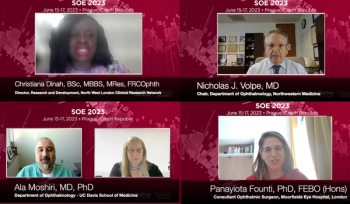
Did you miss the 2023 European Society of Ophthalmology congress? Don't worry – you can catch up with our video coverage.

Antimicrobial resistance is resistance to multiple classes of antibiotics, which makes it extremely challenging to treat infections caused by such organisms.

Artificial intelligence (AI) is going to be highly instrumental in patient care in all medical specialties and will be highly relevant in eye care.
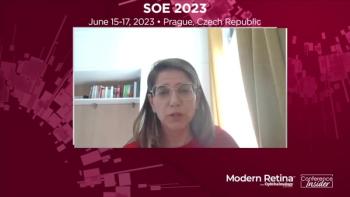
Ophthalmology Times Europe© is proud to cover the European Society of Ophthalmology 2023. We spoke to SOE presenter Panayiota Founti, PhD, FEBO, Consultant Ophthalmic Surgeon & Training Director, Glaucoma Service Moorfields Eye Hospital, London, UK.
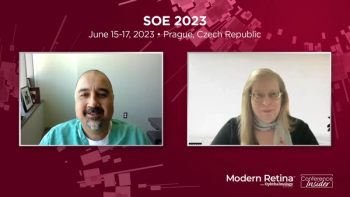
Dr Ala Moshiri provides an overview of current treatment options for diabetic macular oedema.
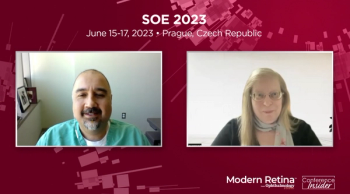
Ala Moshiri, MD, PhD, provides an overview of current treatment options for diabetic macular edema.

Jorge L. Alió, MD, PhD, FEBOphth, shared his pearls situations in which a patient presents with a cataract and corneal opacity at the European Society of Ophthalmology Conference, Prague.
Nicholas Volpe, MD shares insights from his talk titled "Optic Neuropathy Versus Maculopathy" at the European Society of Ophthalmology Congress being held in Prague.
Dr Christiana Dinah discusses her SOE presentation, "Geographic Atrophy: A Mixed Method Study."

Paracentral acute middle maculopathy can develop after excessive intake of caffeine and alcohol according to Obadah Moushmoush, MD.

Omnigen® may be an alternative treatment option for patients with a persistent corneal epithelial defect. The product provides a convenient and effective treatment that can be administered in an outpatient setting.

SOE holds a special place in its heart for the up-and-coming young ophthalmologists and is providing them a number of opportunities to hone their skills and establish professional contacts at this meeting.

The European Society of Ophthalmology (SOE) 2023 Congress will convene from June 15 to 17 in Prague, Czech Republic.
Ronald Zambrano, lab supervisor for the advanced Ophthalmic Imaging Lab at NYU Langone, talks about lamina cribrosa pressure and predicting structural glaucoma progression at this year's ARVO meeting.

Japanese investigators have found an ocular biomarker of cardiovascular diseases.
Dr Edmund Arthur shares his research on the early detection of diabetic retinopathy in underserved communities at this year's ARVO meeting.
Dr T.Y. Alvin Liu talks about predictive AI and its uses in ophthalmology and screening of the eyes at this year's ARVO meeting.
Dr Carl Danzig, MD, FASRS, spoke at this year's ARVO meeting on the post hoc analysis for the GATHER trials regarding vision loss and patients receiving ACP 2/mg versus sham.
Dr Caroline Baumal talks about Apellis' presentations focusing on visual function, imaging and artificial intelligence at this year's ARVO meeting.