

The first-in-human study of the GalNAc-conjugated siRNA joins a fast-moving Stargardt pipeline as the FDA weighs the first potential approval for the disease.
The first-in-human study of the GalNAc-conjugated siRNA joins a fast-moving Stargardt pipeline as the FDA weighs the first potential approval for the disease.

Jayakrishna Ambati, MD, discusses phase 2 K8 findings in geographic atrophy, inflammasome targeting and K8 dosing and delivery.
R. Ross Lakhanpal, MD, FACS, Anu Patel, MD, and Yasha S. Modi, MD, MHS, point to cell replacement in geographic atrophy, care burden, and glycemic control.

The once-daily combination drop is approved by the FDA to treat presbyopia.

Katherine Talcott, MD, discusses phase 2 VERONA findings on the vorolanib intravitreal insert in previously treated DME

The half-life extended FcRn inhibitor showed a 74% peak reduction in IgG in healthy volunteers.

The agency concluded that GLP-1 receptor agonists carry a potential increased risk of the rare optic neuropathy and is adding it to the Warnings and Precautions section of every product's label.

VeonGen aligns with FDA on phase 3 design for VG801, a dual-AAV Stargardt gene therapy, after uncontrolled phase 1/2 BCVA gains.

From the first BLA acceptance for a gene-agnostic optogenetic therapy to the first pivotal gene therapy trial in geographic atrophy, these are the retinal gene therapy milestones of 2026.

Isa S. K. Mohammed, MD, on training refractive surgeons and why lasers make global access harder than for cataract surgery.

Kiril Kiprovski, MD, of NYU Langone shares clinical clues and bedside tests for spotting Lambert-Eaton myasthenic syndrome.

Jayakrishna Ambati, MD, discusses phase 2 K8 results in GA, its inflammasome mechanism, and dosing designed for convenience.

Cataract surgery is not neutral for the vitreous.

Hunter Cherwek, MD, of Orbis discusses summit commitments, eye care workforce training, and AI in low-resource settings.

MyoSpectrumNet pulls 3 public fundus datasets into 1 multi-output framework. Screening and grading accuracy held up against dedicated models, but the authors are open about where joint learning gave ground.

Few people starting tamoxifen require an ophthalmic evaluation during the following year.

Clinical Forum cases examine symptoms, progression, and treatment response.
Uday Devgan, MD, FACS, Jordana G. Fein, MD, MS, and Carl D. Regillo, MD, FASRS, point to IOL education, emerging retina therapies, and treatment burden.

Duravyu missed wet AMD noninferiority twice, DAYBREAK met its end points, and optogenetics won the Nobel as son-vec posted 4-year RP data in an AAO-driven October.
Technician-led screening catches hidden ocular surface disease before cataract surgery and helps decide when to delay surgery.

Murtaza K. Adam, MD, reviews 3 patient cases to explore referral patterns, neovascularization after treatment, and barriers to care.
October spotlights eye-care breakthroughs: phase 3 gene therapies, sustained delivery, and AAO trial data, plus 3 FDA clearances shaping retina, cataract, and TED care.

Now on the company's EYE7 smart glasses platform, Eva is designed to go beyond answering questions about the visual environment by reasoning about user needs and directly controlling the device's vision-enhancement features.

The FDA approved Lucamzi (ranibizumab-blrz), Xbrane's Lucentis biosimilar, for wet AMD and other serious eye conditions, with a US launch planned for 2027.

Andrew G. Lee, MD, and Drew Carey, MD, break down the visual safety of flow-diverting stents for carotid-ophthalmic aneurysms.

Christopher J. Rapuano, MD, discusses emergency eye care access, retina advances and responsible AI use in ophthalmology.

Carreño discusses oral protein-folding correction for RHO-adRP, early-phase trial end points and genetic eligibility.
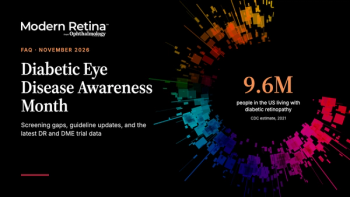
An estimated 9.6 million people in the US have diabetic retinopathy, and roughly 1 in 3 patients with diabetes miss annual eye exams as AI screening and new therapies reshape care.

The FDA approved the Supplemental New Drug Application for phentolamine 0.75% (Ryzumvi, Opus Genetics/Viatris) to treat presbyopia.

A simple stool test may reveal hidden bowel disease in patients whose only symptoms are in their eyes.