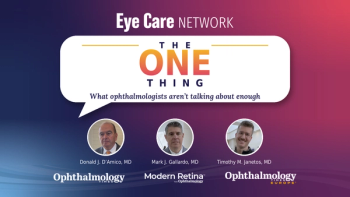
Timothy M. Janetos, MD, Donald J. D’Amico, MD, and Mark J. Gallardo, MD, point to uveitis access, clinical trial rigor, and procedural pharmaceuticals.

Uday Devgan, MD, FACS, co-chair of EyeCon 2026, highlights what makes cataract surgery challenging, when to add MIGS, and why no patient is routine.
One of the defining features of the Ophthalmology Times and Optometry Times
Devgan noted that the United States trains only 500 ophthalmologists per year—and that more are retiring than are being trained. “It’s imperative that we work together as a team to deliver the most amount of patient care to the most people, and of course at the highest level,” he said. Every session at the meeting featured panel discussion with both MDs and ODs, he noted, and attendees watching remotely were encouraged to submit questions in real time.
Devgan presented a one-hour video-based keynote session on the challenges encountered in the operating room during cataract surgery and how to overcome them—designed specifically to bridge the gap between what optometrists see in the clinic and what surgeons face in the OR. He noted that optometrists often see the patient before surgery and after, when they are pseudophakic, but may not fully understand what happened in between.
He outlined several factors that can make a cataract case challenging. Patient expectations are among the most important—a 70-year-old patient who expects to see like a 21-year-old again presents a challenge no surgeon can meet. “No man-made body part gives the same performance as a young, human, healthy body part,” he said. “Whether it’s a lens implanted in your eye, an artificial heart, or a titanium hip, I assure you none of them are as good as being young and healthy with a normal human body part.”
Anatomical considerations also play a significant role—patients with small eyes, crowded anterior chambers, shallow anterior chambers, high hyperopia, and short axial length all present additional surgical difficulty. Poor pupillary dilation is another challenge: the crystalline lens is approximately nine millimeters in diameter, and extracting it through a three-millimeter pupil presents obvious difficulty. Zonular support is equally important, he noted, as any weakness in the zonular fibers presents significant challenges when the patient is supine on the operating table. He also emphasized the microscopic scale of the surgery—the posterior capsule is four microns thin, or approximately one-twentieth the thickness of a human hair, and is clear, making it difficult to see.
On the question of combined cataract and glaucoma surgery, Devgan described the clinical reality that both conditions increase in prevalence with age, making it common for patients presenting for cataract surgery to also have glaucoma or be somewhere on the glaucoma spectrum from ocular hypertension to mild or moderate disease.
He noted that cataract surgery alone lowers intraocular pressure by approximately 20% in most patients—a meaningful effect driven by the replacement of a thick crystalline lens averaging four and a half millimeters in anterior-posterior diameter with a man-made lens less than one millimeter thin, which opens the angle of the eye considerably. Given this, he suggested that a stepwise approach—performing cataract surgery first and then returning for a minimally invasive glaucoma surgery (MIGS) procedure if needed—may be more nuanced than the older thinking of doing both at the same time simply because the surgeon is already in the eye. “The nuanced way is to tailor it to the patient,” he said.
When asked for the one overarching message he hoped attendees would carry back to their practices, Devgan was direct. “There is no routine patient, there is no routine surgery,” he said. “For every patient, that surgery’s going to change the way they see the world every waking moment for the rest of their lives.”
He cautioned against a cookie-cutter approach to patient counseling, examination, surgical decision-making, and surgical technique, describing a surgeon who goes on autopilot and performs the same surgery for every patient as dangerous. “Learning how to tailor what we do surgically to our patients to give them the best vision of their lives—it really is that important of surgery,” he said.