Cataract surgery becomes refractive: learn how IOL choices and preop counseling across distance, intermediate and near turn 20/20 into 20/happy.

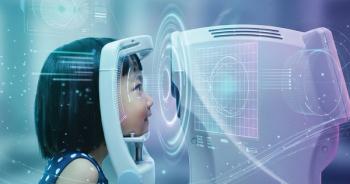
Ultra-widefield pediatric retinal scans plus adaptable AI reveal hidden eye issues during routine visits, enabling comfortable, scalable screening and earlier specialist referrals.
Ibrahim Kanani, a recent Duke University computer science graduate, discusses his work at the Duke Eye Center. The research focuses on using ultra-wide field retinal imaging in children to improve early detection of eye diseases. Unlike traditional eye exams that often require pupil dilation, ultra-wide field imaging can capture a broad view of the retina without dilation. This makes the process more comfortable and accessible for children and opens the door to large-scale, routine screening in primary care and community settings.
In the current study, Ibrahim and his team collect ultra-wide field images from children who are either visiting their pediatrician for annual checkups or seeing an optometrist for a new glasses prescription. Despite these being routine visits, the team has found that about 10% of the children imaged actually need referral to an ophthalmologist. This surprisingly high referral rate underscores how many eye issues may go unnoticed without specialized screening. By identifying problems earlier, the hope is to better preserve children’s vision and intervene before conditions become more serious or harder to treat.
Ibrahim’s role centers on bringing artificial intelligence (AI) into this imaging workflow. His project is an early-stage effort to determine how well existing AI models, which were originally developed for more standard color fundus images, can be adapted to ultra-wide field images. Much of the prior AI work in ophthalmology has focused on these traditional fundus photographs, which differ in appearance and coverage from ultra-widefield images. The key question is whether knowledge learned on one imaging modality can transfer to another.
To explore this, Ibrahim has used a model called RETFound as a baseline. RETFound is trained specifically on retinal images and encodes eye-related visual features. He compares its performance on ultra-wide field images to that of a more generic vision model without any retina-specific training. The results are promising: even without being originally trained on ultra-wide field data, RetFound performs significantly better than a standard baseline model. With additional fine-tuning tailored to the ultra-wide field modality, performance improves further.
These findings suggest that existing retina-focused AI models can serve as a strong starting point for developing tools that analyze ultra-wide field pediatric retinal images. Looking ahead, Ibrahim envisions a future where schools or community clinics could routinely capture retinal images of children and use AI to flag those who need specialist care. This would make eye screening more scalable, proactive, and equitable, helping to catch treatable conditions earlier in life. His current work represents a foundational step toward that vision, demonstrating that leveraging and adapting existing AI models is both feasible and effective for this new imaging context.