
David Hutton of Ophthalmology Times talks with Jay Katz, MD, CMO for Glaukos, and Steven R. Sarkisian, MD, about the Glaukos iDose travoprost implant.
David Hutton of Ophthalmology Times talks with Jay Katz, MD, CMO for Glaukos, and Steven R. Sarkisian, MD, about the Glaukos iDose travoprost implant.

Marc Gleeson, CEO of Azura, sat down with David Hutton, Managing Editor at Ophthalmology Times to discuss the recent positive results from the Phase 2 clinical trial of AZR-MD-001 in patients with contact lens discomfort.
Eric Jennings, MD, from Woolfson Eye Institute, discusses the SMARTCataract cloud-based app from Alcon and its implementation where he practices with David Hutton, Managing Editor, Ophthalmology Times.
Retina experts deliberate on the role of fluorescein angiography in AMD and discuss initiation of anticomplement therapy for geographic atrophy in conjunction with anti-VEGF therapy for neovascular AMD.
Roger Goldberg, MD, presents a case of a patient showing signs of geographic atrophy who subsequently develops nAMD and highlights the favorable outcomes achieved through anti-VEGF therapy.
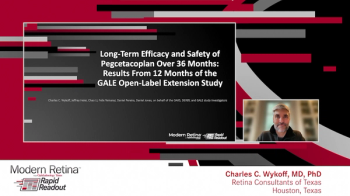
Dr Charles Wykoff presents the results of a post hoc microperimetry analysis from the OAKS study demonstrating the effectiveness of pegcetacoplan in preserving visual function.
Dr Charles Wykoff discussed the study design and key findings from the GALE study, an extension of the pivotal phase 3 OAKS and DERBY trials for pegcetacoplan in geographic atrophy.
David A. Eichenbaum, MD, highlighted new therapies such as faricimab and high-dose aflibercept to reduce the burden of diseases like macular degeneration and diabetic eye conditions while improving patient outcomes during his presentation at EyeCon 2023.
Dilsher Dhoot, MD, presents two cases involving DME and CRVO, that show remarkable anatomical improvement with a biosimilar comparable to those achieved with reference biologics.
Dilsher Dhoot, MD, provides an overview of biosimilars in retinal diseases and discusses how he identifies patients suitable for biosimilar therapy.
The expert panel discusses what constitutes treatment failure in anti-VEGF therapy for nAMD and examines how various treatments may yield varying results in managing PED.
Adrienne Scott, MD, presents a case of neovascular AMD with PED in a patient who experiences a stroke while on anti-VEGF therapy.
Sunil Srivastava, MD, shares his experience using dexamethasone and fluocinolone acetonide implants to manage chronic non-infectious uveitis.
Sunil Srivastava, MD, details his approach to treating chronic non-infectious uveitis and macular edema, highlighting when to transition away from topical therapies.
Sunil Srivastava, MD, presents a case of postoperative macular edema, which required him to move beyond short-acting steroids to control the inflammation.
Sunil Srivastava, MD, presents a case of a 68-year-old female with eye pain and decreased vision following complicated cataract surgery.
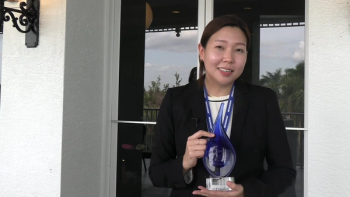
Moon Jeong Lee, MD, Wilmer Eye Institute, Johns Hopkins University School of Medicine, Baltimore, Maryland, was honored as the recipient of the inaugural Visionary in Eye Care Resident Recognition Award for the category of Best in Ophthalmology during the EyeCon 2023 conference, December 1-2, at the Marriott Sanibel Harbour Resort and Spa in Sanibel, Florida.

Marta Stevanovic, MD, Massachusetts Eye and Ear, Harvard Medical School, Boston, was honored as the recipient of the inaugural Visionary in Eye Care Resident Recognition Award for the category of Best in Retina during the EyeCon 2023 conference, December 1-2, at the Marriott Sanibel Harbour Resort and Spa in Sanibel, Florida.
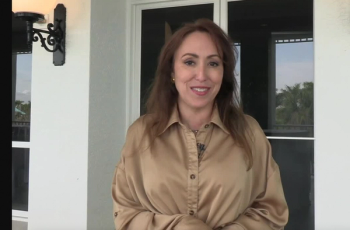
Analisa Arosemena, MD, underscores the importance of year-round glaucoma control through extended-release medications and laser treatments at EyeCon 2023.
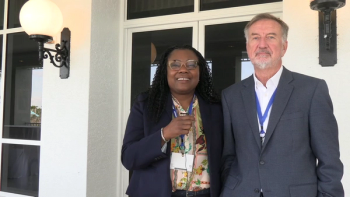
Oluwatosin U. Smith, MD, and Peter J. McDonnell, MD, discuss their experience at EyeCon 2023, highlighting the latest updates in retina, cataract and refractive surgery, and the growing epidemic of myopia worldwide.
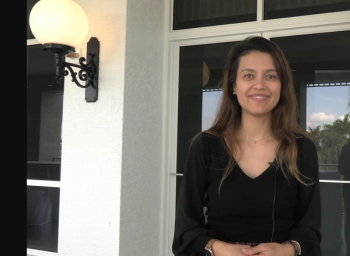
Jennifer Loh, MD, discusses the significance of maintaining a healthy ocular surface before surgery and exploring collaborative approaches for improved patient comanagement between ophthalmologists and optometrists at EyeCon 2023.
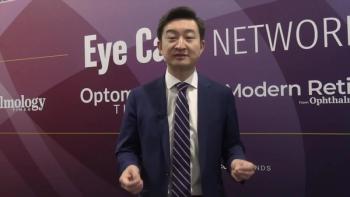
Benjamin Y Xu, MD, spoke with the Ophthalmology Times team about the real-world safety analysis of patients treated with intracanalicular dexamethasone insert using IRIS Registry at this year's American Academy of Ophthalmology meeting.

Rupa Wong, MD, spoke with the Ophthalmology Times team about Luminopia, the first FDA-approved digital therapeutic for amblyopia at this year's American Academy of Ophthalmology meeting.

At this year's ESCRS meeting, industry leaders shared advice for young ophthalmologists–and what they wish they'd known earlier in their careers
Expert retina specialists deliberate on their approach to treating DME, emphasizing their primary treatment choice and cases where they would use PRP laser therapy and steroids alongside anti-VEGF treatments.
Carl Danzig, MD, presents a case involving a patient with both DME and PDR, showcasing the impressive anatomic improvement achieved by treating with a dual anti-VEGF and Ang2 inhibitor.
Rishi Singh, MD, discusses the criteria for identifying patients who would benefit from biosimilar therapy.
Rishi Singh, MD, presents a case of neovascular age-related macular degeneration and diabetic macular edema demonstrating how the use of ranibizumab biosimilars can yield remarkable anatomical improvements comparable to those expected with reference biologics.
Rishi Singh, MD, provides an overview of biosimilars in the context of retinal diseases and discusses their significance within the healthcare system.
Mohammed Genead, MD, CEO of Aviceda spoke with the Ophthalmology Times team about the company's Phase II/III SIGLEC trial part 1 results, which were shared at this year's American Academy of Ophthalmology meeting.