
David Eichenbaum, MD, FASRS discusses a case of exudative macular degeneration and opted for aflibercept 8 mg as treatment, which led to significant improvements in visual acuity and anatomical features.

David Eichenbaum, MD, FASRS discusses a case of exudative macular degeneration and opted for aflibercept 8 mg as treatment, which led to significant improvements in visual acuity and anatomical features.
Andrew G. Lee, MD, outlines his stance on whether all patients with idiopathic intracranial hypertension should have a lumbar puncture, emphasizing clinical judgment and treatment strategies.
Judy Kim, MD and Peter Kaiser, MD reflect on the varying criteria for shortening or extending treatment intervals in clinical trials, emphasizing the need for standardization in large-scale studies. They highlight the importance of adapting trial criteria to clinical practice.
Experts discuss the efficacy and durability of newer therapies, focusing on faricimab and the high dose of aflibercept, highlighting the promising clinical trial results, maintaining comparable visual acuity efficacy while achieving longer durability
Judy Kim, MD and Peter Kaiser, MD discuss the use of biosimilars and the potential introduction of biosimilar aflibercept for treating retinal diseases. Experts discuss their preferences for specific drugs and highlight the evolving landscape, anticipating challenges in drug selection and emphasizing the need for collaboration between retinal specialists and insurance companies to optimize patient care.
In this insightful discussion on changing therapeutic approaches in neovascular age-related macular degeneration (nAMD) and diabetic macular edema (DME), Judy Kim, MD and Peter Kaiser, MD address barriers like step therapy and the impact of insurance-guided choices on treatment outcomes. The conversation emphasizes the need for a personalized approach, citing clinical trial data while acknowledging the challenges of aligning real-world practices with stringent trial protocols.
Sruthi Arepalli, MD, discusses the case of a patient with syphilis and sheds light on the complexities of diagnosing a masquerading syndrome.
Marsha Link, PhD, uses three words—Imagine, Prepare, and Optimize—to encourage women to assess their current leadership journey, strategically plan for advancement, and explore new opportunities for growth and impact in vision care.
Baruch Kuppermann, MD, PhD, discusses interim results from the first in-human Phase 2 RIPPLE-1 Trial of a dexamethasone implant for diabetic macular edema and retinal vein occlusion.
Ramin Tadayoni, MD, PhD, highlights data from the BALATON and COMINO Phase 3 studies about faricimab, respectively, in branch retinal vein occlusion and central retinal vein occlusion.
John T. Thompson, MD, FASRS, shares pearls for navigating the diverse landscape of career paths in ophthalmology as the Distinguished Guest Speaker at the 24th Annual Retina Fellows Forum.
Dr Charles Wykoff presents the results of a post hoc microperimetry analysis from the OAKS study demonstrating the effectiveness of pegcetacoplan in preserving visual function.
Dr Charles Wykoff discussed the study design and key findings from the GALE study, an extension of the pivotal phase 3 OAKS and DERBY trials for pegcetacoplan in geographic atrophy.
Caroline Baumal, Chief Medical Officer at Apellis, spoke with Modern Retina about the pegcetacoplan GALE extension study for geographic atrophy. She also shared insights regarding her career transition, underscoring the significance of mentorship and a passion for one's work during this year's American Academy of Ophthalmology meeting in San Francisco.
Peter K. Kaiser, MD, highlights approaches in development for patients with dry age-related macular degeneration that have the potential not only to prevent vision loss but also to improve visual acuity.
Arshad M. Khanani, MD, MA, FASRS, highlights the fluid resolution with faricimab and the need for loading doses, especially in high-needs switch patients with nAMD or DME.
Arshad M. Khanani, MD, MA, FASRS, discusses rapid improvement with faricimab in several anatomic parameters in treatment-naïve and previously treated patients with nAMD and DME in the TRUCKEE and TAHOE studies.
Ophthalmology experiences lower burnout rates than other medical specialties, but some may consider the exploration of alternative paths to maintain their professional fulfillment, explains Peter J. McDonnell, MD.
Kerrie Brady, president and chief executive officer of OcuTerra Therapeutics, shares progress in their Phase 2 DR:EAM Diabetic Retinopathy study, with promising results expected in Q1 2024 for their innovative eye drop treatment, OTT166.
Michael Engelbert, MD, PhD, discusses how personalized faricimab dosing shows promise in extending dosing intervals for patients with wet age-related macular degeneration, which can enhance long-term treatment outcomes and patient adherence.
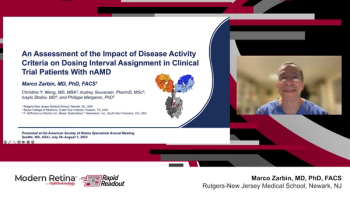
Dr Marco Zarbin presents his talk from the 2023 ASRS annual meeting, where he explores the impact of disease activity criteria on drug durability estimations in clinical trials and includes a comparative analysis across multiple clinical trials in neovascular AMD (age-related macular degeneration).
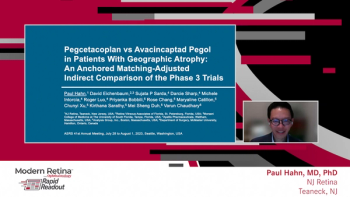
A retina specialist shares his presentation from the 2023 ASRS Annual Meeting, which describes a study comparing the efficacy of 2 FDA-approved treatments for geographic atrophy based on an anchored matching-adjusted indirect comparison of phase 3 trial findings.
We asked, "What research at ASRS 2023 do you find exciting or interesting?" Here's what Paul Hahn, MD, Kerrie Brady, BPharm, MBA, MS, and Michael Singer, MD had to say!
Our team spoke with several researchers and industry professionals at the 2023 American Society of Retina Specialists meeting in Seattle, Washington. We asked them, "What research here do you find exciting or interesting?" Here's what Tarek Hassan, MD, Nancy Lurker, and J. Fernando Arevalo, MD, PhD, FACS, FASRS, had to say!
At the 2023 American Society of Retina Specialists meeting in Seattle, Washington, we asked some of the presenters, "What research here do you find exciting or interesting?" Here's what Diana Do, MD, Shawn Kavoussi, MD, and Durga Borkar, MD, MMCi had to say!
"What research at the 2023 ASRS meeting do you find exciting or interesting?" Here's what Aaron Lee, MD, Megan Baldwin PhD, and Carl Danzig, MD had to say!
Priya Vakharia, MD, spoke with our team about her presentation at the Women in Ophthalmology Summer Symposium being held in Marco Island, Florida.
Sruthi Arepalli, MD, spoke with our team about the current landscape of geographic atrophy (GA) and her presentation at the Women in Ophthalmology Summer Symposium being held in Marco Island, Florida.
Maria H. Berrocal spoke with our team about her presentation at the Women in Ophthalmology Summer Symposium being held in Marco Island, Florida.
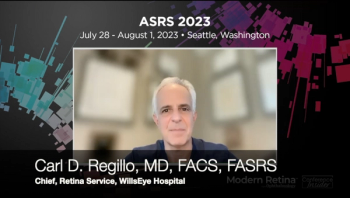
Carl Regillo, MD, FACS, FASRS, spoke with our team following the annual ASRS meeting in Seattle, Washington to share insights from his presentation titled, "Modulation of Macrophages and Complement Dysfunction in Non-exudative AMD utilizing novel, sialic-acid coated nanoparticles." Aviceda Therapeutics is unlocking the proteogenomic code of AMD to target proteins and pathways linked to macular degeneration.