

ASCRS 2026 data show smarter EDOF and toric choices after LASIK/PRK, plus reverse optic capture to relieve negative dysphotopsia.
ASCRS 2026 data show smarter EDOF and toric choices after LASIK/PRK, plus reverse optic capture to relieve negative dysphotopsia.

A trio of ASCRS presentations collectively offer insight to surgeons, suggesting that glaucoma drops harm meibomian glands, while combining cataract surgery with MIGS can boost long-term IOP control.
Oluwatosin U. Smith, MD, provides an overview of angle-based techniques, cyclodialysis cleft repair, and minimally invasive approaches to glaucoma surgical complications.

Expanded guidance incorporates advanced diagnostics and reinforces treatment of conditions such as Demodex blepharitis and neuropathic pain, explains Christopher E. Starr, MD, FACS.

Specialists discuss diagnostic technologies, treatment strategies and research that are improving outcomes for young patients.

Chang described how the ASCRS Functional Vision Working Group is proposing a structured framework centered on visual quality, visual range, and visual symptoms to guide lens classification.

The decision lengthens the approved treatment period outlined in the prescribing information and may lessen the need to change therapies for patients who continue to show a lasting response.

The trial is evaluating AURN001, a single-administration regenerative cell therapy for corneal edema secondary to corneal endothelial dysfunction

Engineered ocular bacteria act as a long-lasting eye drop, secreting IL-10 to speed corneal healing and hint at future living therapies.

The phase 3 study was a randomized, double-masked, placebo-controlled, multicenter trial evaluating subcutaneous teprotumumab administered every 2 weeks for 24 weeks.


Immunovant, along with partner HanAll, will assess future plans for the development of batoclimab and provide an update at a future, unspecified date

MALBEC (NCT07440225) is a randomized, double-masked trial evaluating the safety and efficacy of MK-8748 at 2 dose levels versus control (aflibercept 2mg).

Five-year pediatric Boston KPro results show vision gains, but low retention and high membrane, melt and glaucoma risks persist.


Bovelle reflects on the significance of this leadership milestone and shares her vision for mentorship, innovation, and global engagement across ophthalmology, optometry, and industry.

Regeneron announced that the FDA has amended the EYLEA HD label after the approval, adding 96-week results from the PULSAR wAMD trial and the PHOTON DME trial.

Biogen’s $5.6B Apellis deal boosts GA and renal complement therapies, spotlighting SYFOVRE benefits, safety signals, and future access.

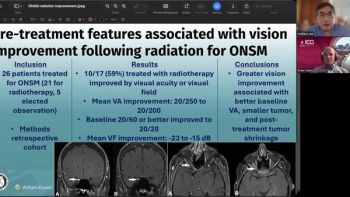
Andrew G. Lee, MD, and Drew Carey, MD, review how clinical and imaging findings relate to vision recovery after radiotherapy for optic nerve sheath meningioma.

A neuroprotective investigational candidate for optic neuritis (ON) has received Priority Medicines (PRIME) designation from the European Medicines Agency (EMA).

The Opti-GAIN study from Complement Therapeutics is assessing the safety, tolerability, and preliminary efficacy in GA secondary to age-related macular degeneration (AMD) of CTx001.

Images showed that Parkinson’s disease is associated with a thicker photoreceptor nuclear layer and a thinner layer of photoreceptor processes.

The ongoing GARDian3 study is designed to assess whether a single subretinal administration of OCU410ST can slow structural disease progression in patients with ABCA4-associated retinopathy.

This study sheds light on the use of 0.05% atropine, which has been reported to be effective against myopia progression in some but not all studies.
The Opti-GAIN study from Complement Therapeutics is assessing the safety, tolerability, and preliminary efficacy in GA secondary to age-related macular degeneration (AMD) of CTx001.
The formulation combines 2 pharmacologic agents: carbachol, a direct-acting cholinergic agonist, and brimonidine tartrate, an alpha-2 adrenergic receptor agonist.


The University of Rochester’s Flaum Eye Institute is embedding behavioral health into ophthalmology to improve patient care and clinician support.

In the JADE trial, OLN324 demonstrated numerically greater visual acuity gains and evidence of sustained retinal drying with fewer retreatments during a treatment-free follow-up period, compared with faricimab.