
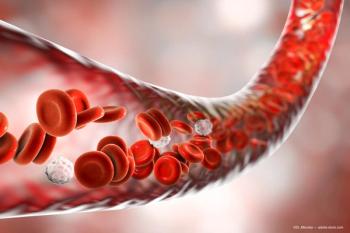
The team of Japanese researchers found that the choroidal MBR in the nasal region is correlated with systemic arterial stiffness and is significantly lower in patients with coronary artery multivessel disease.

The team of Japanese researchers found that the choroidal MBR in the nasal region is correlated with systemic arterial stiffness and is significantly lower in patients with coronary artery multivessel disease.

Hydrogen-rich water may have a place in treatment of retinal degeneration. The team of investigators found that the hydrogen-rich water significantly improved the retinal blood flow (RBF) dysregulation in type 2 diabetic mice.
Thomas V. Johnson, MD, PhD recaps the research presentation "Retinal Engineering and RGC Replacement: Enhancing Integration of Transplanted RGCs at ARVO 2023.

The results indicated that SB15 had similar efficacy, safety, immunogenicity, and pharmacokinetics compared to aflibercept out to week 56 of the phase III trial.
David Szanto, a medical student at Stony Brook, and working with the Department of Neurology at the Icahn School of Medicine at Mount Sinai, describes how an algorithm finds recurring patterns in the visual fields and the ganglion cell-inner plexiform layer thicknesses, and helps clinicians understand how prevalent those patterns are throughout the entire data.
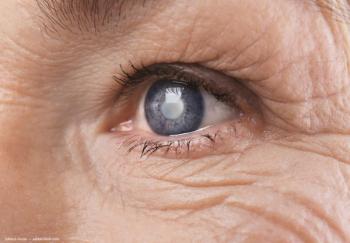
In a mouse model of glaucoma, defective calcium clearance was seen as a characteristic feature of early damage to the retinal ganglion cells (RGC).

Dr Ong and colleagues undertook a retrospective study of patients who underwent primary repair of uncomplicated RRDs at the Wilmer Eye Institute to examine the baseline, surgical, and postoperative characteristics that affect best-corrected VA (BCVA) outcomes.
Sally S. Ong, MD, shares the key takeaways from her presentation, Predictors of Poor Visual Outcome After Repair of Uncomplicated Rhegmatogenous Retinal Detachments, at the 11th Annual Vit-Buckle Society meeting.
Sean D. Adrean MD, FAAO, discusses the key takeaways from his presentation, Purposeful Pneumatic Induced Resorption of Submacular Fluid in Macula-off Retinal Detachments, at the 11th Annual Vit-Buckle Society meeting, April 13 to 15, in Las Vegas, Nevada.

Jennifer Lim, MD, FARVO joined David Hutton, Managing Editor, Ophthalmology Times®, to discuss her presentation on keratoprosthesis combined with vitrectomy surgery given at this year's Vit-Buckle Society meeting.

The 2023 Association for Research in Vision and Ophthalmology (ARVO) annual meeting promises to provide numerous opportunities to meet up with old friends and colleagues and forge relationships with new ones as well as enhance future research and practice endeavors.

The Association for Research in Vision and Ophthalmology (ARVO) 2023 annual meeting is convening in New Orleans from April 23 to 27 at the Ernest N. Morial Convention Center. The theme of the Annual Meeting speaks both to the mechanistic diversity in ocular disease in addition to the diversity of vision scientists who are from multiple backgrounds and perspectives.
The various aspects of home monitoring for patients with age-related macular degeneration are discussed in this point/counterpoint by Prof. Rufino Silva, University of Coimbra / Coimbra Hospital and University Centre, Portugal, and Univ.-Prof. Dr. med. Robert P. Finger, PhD, Department of Ophthalmology, University of Bonn, Germany, during the 14th annual Congress on Controversies in Ophthalmology in Lisbon, Portugal.
Pedro Fonseca, MD, Coimbra Hospital and University Centre, Portugal, and Andrew G. Lee, MD, Blanton Eye Institute, Houston Methodist, Texas, USA, discuss the various pros and cons of offering teprotumumab for all patients with thyroid eye disease.

In a keynote lecture at the 14th Annual Congress on Controversies in Ophthalmology in Lisbon, Hendrik Scholl, MD, co-founder and director of the Institute of Molecular and Clinical Ophthalmology Basel, discussed its mission to unravel the mysteries of vision and human eye disease.
Angela Carneiro, MD, PhD, discusses her position on a discussion titled Presence of Macular Neovascularization on OCTA is Predictive of Subsequent Exudation with David Hutton, Executive Editor, Ophthalmology Times®.
Antonio Campos, MD, PhD, discusses his position on a discussion titled Durability Associated with Multi-target Therapies is Superior to anti-VEGF Mono-target Therapy in AMD with David Hutton, Executive Editor, Ophthalmology Times.®

Delegates will analyze the most relevant and controversial issues within the field of ophthalmology at this year’s congress in Lisbon, Portugal, from March 24 to 25.

A poll for retina specialists: Let us know if you will attend the 14th annual Congress on Controversies in Ophthalmology.
David S. Boyer, MD, presented data from the PHOTON study examining the safety and efficacy of high-dose aflibercept for treatment of diabetic macular edema at the 2023 Angiogenesis, Exudation, and Degeneration conference.

The Keralink trial results answered an important question regarding the time at which corneal cross-linking should be performed.
Jay Chhablani, MD, provides an overview of the Subthreshold Ophthalmic Laser Society treatment guidelines for patients with diabetic macular edema.

Yusuke Oshima, MD, PhD, in a presentation at the 38th Asia-Pacific Academy of Ophthalmology Congress, Kuala Lumpur, Malaysia, discussed the advantages of using a beveled-tip ultra-speed probe for complete vitreous shaving during retinal detachment vitrectomies.
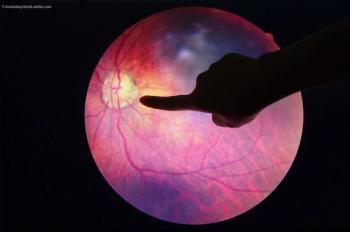
Voraporn Chaikitmongkol, MD, discussed step therapy and reported the results of a major study, the Diabetic Retinopathy Clinical Research (DRCR) Protocol AC, at the 38th Asia-Pacific Academy of Ophthalmology Congress, in Kuala Lumpur, Malaysia.

Children who ultimately develop pathologic myopia may have a different retinal appearance at an early age.
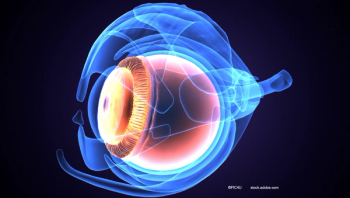
Greater anatomic improvements (central subfield thickness reduction, proportion with absence of subretinal fluid and intraretinal fluid) were seen with faricimab versus aflibercept during the matched dosing period (week 4, week 8, and week 12).
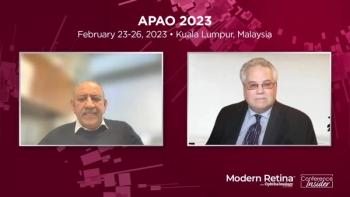
Arun Singh, MD, discusses Retinoblastoma in 2023 and the advancements of tumor chemotherapy from his presentation at the Asia-Pacific Academy of Ophthalmology (APAO) 2023 conference.

The agenda includes the Opening Ceremony, Women in Ophthalmology Luncheon, and Young Ophthalmologists’ Night, and that's only a sampling. The results of the APAO-Asia-Pacific Ocular Imaging Competition will also be announced.

The money raised this year will help support the Princess Elizabeth National School for Special Education in Malaysia and APAO Young Ophthalmologist activities.

APAO returns to an in-person congress for the first time since the start of the COVID-19 pandemic.