Clinical Brief: Aflibercept 8 mg for nAMD
Main Discussion Topics
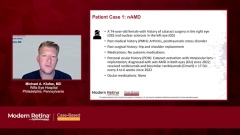
- Treatment Response and Switching Therapies: A woman aged 74 years with suboptimal control of nAMD in the right eye despite 17 injections of ranibizumab/biosimilar, whereas the left eye showed good control.
- High-Dose Aflibercept Initiation: Decision to start aflibercept 8 mg for better disease control and potential treatment interval extension in both eyes.
- Extended Treatment Intervals: Patient demonstrated improved disease control with aflibercept 8 mg, allowing successful extension from 6 weeks to 8 weeks and eventually 10 weeks between treatments.
- Long-term Response Patterns: Vision improved over time with continued reduction in central subfield thickness, even with extended treatment intervals.
Key Points for Physicians
- Patients may show improved disease control over time with extended treatment intervals of aflibercept 8 mg.
- Residual edema or subretinal fluid does not necessarily require reducing treatment intervals if vision remains stable and no hemorrhage is present.
- Treatment extension to 8 to 10 weeks was possible while maintaining disease control.
- Consider patient preferences and treatment burden when selecting the treatment agent and intervals.
Notable Insights
- Some physicians prefer using the same agent in both eyes, even with differential response.
- Clinicians may have varying tolerance for subretinal vs intraretinal fluid.
- No specific demographic or optical coherence tomography features reliably predicted superior response to particular agents.
- Determining nonresponse vs lack of durability remains challenging, with some patients potentially requiring very frequent anti-VEGF suppression.
Clinical Significance
The case demonstrates that aflibercept 8 mg offers effective disease control for nAMD with the potential for extended treatment intervals, reducing treatment burden while maintaining visual outcomes.