
Our team spoke with Michael Ip, MD, to get his perspective on the 2023 ASRS meeting in Seattle, Washington and why he thinks these are the most valuable topics to understand and review for retina specialists.

Our team spoke with Michael Ip, MD, to get his perspective on the 2023 ASRS meeting in Seattle, Washington and why he thinks these are the most valuable topics to understand and review for retina specialists.
At the 2023 ASRS meeting in Seattle, Washington, Diana Do, MD joined our team to discuss the 2-year data on the PHOTON study, which involved 8 milligrams of aflibercept for diabetic macular edema.
Mark Breazzano, MD, FACS, who is presenting Outcomes and Clinical Features Predictive of Fungal Endophthalmitis at the 2023 ASRS meeting in Seattle, Washington spoke with our team about this research.
Carl Danzig, MD, spoke with our team to share the exciting results of the GATHER 1 and GATHER 2 clinical trials for avacincaptad pegol for the treatment of geographic atrophy at the 2023 ASRS annual meeting.
At the 2023 ASRS meeting in Seattle, Washington, Aaron Lee, MD, spoke with our team about his research and how changes are making new training possible. He shared how research and new techniques are expanding the options for deep learning in ophthalmology.

Jennifer I. Lim, MD, FARVO, FASRS shares insights from her presentation on "Detection of early diabetic retinopathy using OCT-A blood flow analysis."
Our team caught up with Baruch Kupperman, MD, PHD who is presenting, "Improving vision and dry AMD matching mechanism with the right patient population and stage of disease" to learn more about this topic.
Cochair Peter J. McDonnell, MD, highlights what this year’s conference will mean for clinicians and addresses the anticipated increased patient volume.

Andrew Lee, MD, Andrew Carey, MD, and Elizabeth Fortin, MD, sit down on this episode of the NeuroOp Guru to discuss neuro-ophthalmology, interprofessional eConsults, and whether they provide timely and valuable guidance

SriniVas R. Sadda, MD, discusses being president-elect of ARVO, as well as AI research being conducted at Doheny Eye Institute.
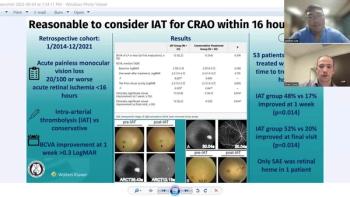
Andrew Lee, MD, and Andrew Carey, MD, sit down on another episode of the NeuroOp Guru to discuss IAT for CRAO within 16 hours.
Maria Montero, MD, of Orbis sits down with David Hutton of Ophthalmology Times, to discuss technology and training for cataract surgery, including simulation, and telementoring.

Kaushal Solanki, PhD, discusses how ophthalmologists can now use the Topcon NW400 retinal camera with its EyeArt AI system to automatically detect diabetic retinopathy.

Paul Singh, MD, shares key takeaways from the roundtable meeting and other surgical pearls to enhance phacoemulsification outcomes.
Paul Singh, MD, demonstrates the advantages of cutting-edge phacoemulsification technologies through surgical videos, showcasing their capability to prevent post-occlusion surges and maintain optimal chamber stability.
Paul Singh, MD, utilizes surgical videos to illustrate the dynamics of a post-occlusion surge and highlights how it can result in anterior chamber instability and posterior capsule rupture.

On this episode of the NeuroOp Guru video blog, Andy Lee, MD, and Drew Carey, MD, discuss the use of fluoxetine in patients with visual field loss after suffering a stroke.

Neda Shamie, MD, explains how her practice has established procedures for incorporating light adjustable lenses into their cataract surgery workflow.
Neda Shamie, MD, reviews the case of a 56-year-old photographer who desires excellent midrange and distance vision with high contrast sensitivity.
Neda Shamie, MD, discusses the factors to consider when selecting cataract lenses for patients with monovision and emphasized how light adjustable lenses offer flexibility in correcting vision to the desired target after surgery.
Neda Shamie, MD, presents a case of a 65-year-old college professor with monovision who sought freedom from glasses following cataract surgery.
In a presentation at the American Society of Cataract and Refractive Surgery meeting in San Diego, Kenneth A. Beckman, MD, FACS, discussed the current status of corneal crosslinking with some emerging treatments, including epi-on crosslinking.
Diana V. Do, MD, presented details of the PHOTON study at the Association for Research in Vision and Ophthalmology annual meeting, held recently in New Orleans, highlighting the safety and efficacy of 8 milligrams of aflibercept.
Steven Greenstein, MD, sat down with David Hutton, Managing Editor, Ophthalmology Times®, to discuss his presentation about the 10-year follow-up for collagen cross-linking and keratoconus ectasia.
Jeff Wongs, MD, discussed his study to assess the benefits of cryopreserved amniotic membrane prior to cataract surgery to restore the ocular surface and improve the accuracy of pre-op biometric readings

Jason Bacharach, MD, and Chris Pearson discussed the Preservative Freedom coalition from Théa Pharmaceutical at the 2023 ASCRS annual meeting in San Diego.

Lori Pacheco, RN, CRNO, discussed sports-related eye injuries and how to prevent them at the 2023 ASCRS annual meeting in San Diego.

Patrick Spencer, DO, discussed the safety and effectiveness comparison of hydrogel-based intracanalicular dexamethasone insert placement in the lower versus the upper punctum at the 2023 ASCRS annual meeting in San Diego.
Vivek Srinivasan, PhD, sat down with David Hutton, Managing Editor, Ophthalmology Times®, to discuss his presentation about using visible light, OCT to image the retina at this year's ARVO meeting.

John Hovanesian, MD, discussed his paper on the Apthera small aperture implant for patients with low degrees of astigmatism at the 2023 ASCRS annual meeting in San Diego.