
At this year's ASCRS meeting in Boston, Massachusetts, Leonard Borrmann, CEO at Centricity Vision, about the company's new product ZEPTOLink, including first-in-human data.

At this year's ASCRS meeting in Boston, Massachusetts, Leonard Borrmann, CEO at Centricity Vision, about the company's new product ZEPTOLink, including first-in-human data.
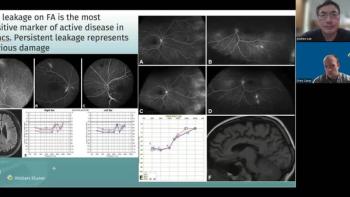
Andrew Lee, MD, and Andrew Carey, MD, sit down on another episode of the NeuroOp Guru to discuss Susac syndrome, and how leakage on fluorescein angiogram might be the most sensitive marker of activity of disease.
Hema Ramkumar, an ophthalmologist and founder of Oculogenex, sat down with David Hutton of Ophthalmology Times to discuss their connection with NASA and their experiment on macular degeneration-treated mice in space.

Neda Nikpoor, MD, shares highlights from her presentation on the Light Adjustable Lens during an ASCRS symposia on IOL calculations.

Elizabeth Yeu, MD, discusses a case report for how the triple procedure can be beneficial for different patient populations in her ASCRS presentation, 'Human corneal endothelial cell transplantation combined with cataract extraction and PCIOL in subject with corneal edema.'
Paul Harasymowycz, MD, details his presentation "Decade-Long Outcomes of Two First-Generation Trabecular Micro-Bypass Stents with Cataract Surgery in Primary Open-Angle Glaucoma" from this year's ASCRS meeting in Boston, Massachusetts.
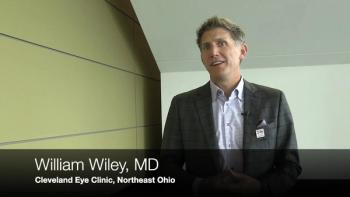
William F. Wiley, MD, shares some key takeaways from his ASCRS presentation on binocularity and aperture optics.
Anthony Wallace, US Surgical vice president and general manager for Bausch + Lomb, reviews the latest advancements and updates in an interview with Ophthalmology Times.
Dan Tran, MD, shares key takeaways from his presentation, including a grading scale for incisions created with femtosecond laser.
Rahul S Tonk, MD, MBA, sat down to discuss a roundtable discussion he had on DMEK and DSEK surgery at this year's ASCRS meeting held in Boston, Massachusetts, from Friday, April 5, to Monday, April 8, 2024.
Alejandro Espaillat, MD, sat down to discuss his presentation on pearls for the anterior segment surgeon at this year's ASCRS meeting held in Boston, Massachusetts.
Mark J. Gallardo, MD, highlighted the results from a phase 2 clinical trial of a travoprost intracameral implant in open-angle glaucoma or ocular hypertension.
George O. Waring IV, MD, FACS, provides an overview of his presentation at ASCRS 2024, highlighting outcomes for the safety and effectiveness of LASIK performed using an updated laser ablation algorithm for the correction of myopia and myopic astigmatism.
Neda Nikpoor, MD, sat down to discuss her presentation on the single-site study on the effectiveness of a sterile model with two ALLYs, in two operating rooms against a model with only one laser for two rooms at this year's ASCRS meeting held in Boston, Massachusetts.
Sean Hanlon, CEO of CoFi, a payment software company, talks about the company's recent integration with CareCredit.
Rich Small, CEO of Neurotech Pharmaceuticals, provides an update on the months ahead for NT-501 encapsulated cell therapy
Ula Jurkunas, MD, sat down to discuss her presentation on the management of anterior corneal disease at this year's ASCRS meeting held in Boston, Massachusetts.
Roger Kennedy, director of marketing at BioTissue sat down to discuss the new products the company will be unveiling at this year's ASCRS meeting held in Boston, Massachusetts.
Jennifer Loh, MD, sat down to discuss her presentation on major eye issues that can interfere with refractive cataract surgery, specifically dry eye disease, at this year's ASCRS meeting held in Boston, Massachusetts.
Experts discuss the use of steroids, particularly in the context of diabetic macular edema (DME). The inflammatory nature of DME reveals the effectiveness of steroids, especially in cases where persistent fluid remains despite anti-VEGF treatment.
Experts discusses concerns related to the use of new agents, focusing on intraocular inflammation (IOI) and potential batch variations in biologics faricimab and aflibercept. He emphasizes close monitoring for IOI and advises clinicians to scrutinize patients for any signs of inflammation during follow-up visits.
Peter Kaiser, MD shares his early experiences with faricimab and high dose aflibercept for nAMD and DME. He notes positive outcomes, especially with hard-to-treat patients, and emphasizes the ongoing evaluation of patient response to treatment.
Zachary Robertson, MD, a retina specialist at the University of Texas Southwestern Medical Center talked with David Hutton of Ophthalmology Times about the upcoming solar eclipse and what potential damages the event could cause on the retina.

Yehia Hashad, executive vice president, research and development, and Chief Medical Officer at Bausch + Lomb sat down with David Hutton of Ophthalmology Times to talk about the upcoming solar eclipse and what ophthalmologists can do to promote safe viewing of the event for their patients.
Peter Kaiser, MD discusses the utilization of newer agents, faricimab and high dose aflibercept, for refractory patients who haven't responded well to previous treatments and for patients doing well but aiming to extend dosing intervals.
Experts discuss the use of steroids, particularly in the context of diabetic macular edema (DME). The inflammatory nature of DME reveals the effectiveness of steroids, especially in cases where persistent fluid remains despite anti-VEGF treatment.
Paul Badawi, co-founder and CEO of Sight Sciences, sits down with host Neda Shamie, MD, to discuss his journey into the field of eye care, what motivates him, the transformative approach to glaucoma patient care, and the spark that led him and his ophthalmologist brother, David Badawi, MD, to start the company together.
Experts discuss the approach to loading doses in the context nAMD and DME. Kaiser, MD explains that loading doses may not be necessary based on studies like the CAT study, while he highlights the importance of individualized treatment plans tailored to the specific needs of each patient and the nuances of different retinal diseases.
Judy Kim, MD and Peter Kaiser, MD discuss the significance of fluid dynamics in nAMD and DME, highlighting the detrimental effects of fluid fluctuations and emphasize the importance of minimizing these fluctuations to achieve better visual outcomes.
Judy Kim, MD and Peter Kaiser, MD reflect on the varying criteria for shortening or extending treatment intervals in clinical trials, emphasizing the need for standardization in large-scale studies. They highlight the importance of adapting trial criteria to clinical practice.