
Martin Zinkernagel, MD, PhD, sat down with Hattie Hayes, Editor of Ophthalmology Times Europe, to discuss his time on the sustainability expert panel Study at the American Society of Retina Specialists meeting held in Stockholm, Sweden.

Martin Zinkernagel, MD, PhD, sat down with Hattie Hayes, Editor of Ophthalmology Times Europe, to discuss his time on the sustainability expert panel Study at the American Society of Retina Specialists meeting held in Stockholm, Sweden.

Srinivas Sai Kondapalli, MD, sat down with Sydney M. Crago, Assistant Managing Editor of Ophthalmology Times and Modern Retina, to discuss outer retinal tubulations in lesion growth for subfoveal and non-subfoveal GA.

The drug performed well in the various subgroup analyses of patients with and without previous treatment for diabetic macular edema (DME).

Sydney M. Crago, Assistant Managing Editor of Ophthalmology Times and Modern Retina, spoke with attendees, who shared which topics they are most looking forward to discussing at the ASRS meeting held in Stockholm, Sweden.
Jennifer I. Lim, MD, FARVO, FASRS, sat down with Sydney M. Crago, Assistant Managing Editor of Ophthalmology Times and Modern Retina, to discuss her ASRS 2024 presentation, "Differential Artery-Vein Analysis Improves OCTA Performance for Artificial Intelligence Classification of Diabetic Retinopathy."
A Retina expert discusses approaches for treating geographic atrophy in patients who also have neovascular AMD, presenting specific patient cases and providing key insights for successfully managing such cases.
Carl D. Regillo, MD, FACS, FASRS presents a case study of a patient with bilateral geographic atrophy, discussing the decision-making process for determining which eye to treat first, considering factors such as the extent of atrophy and vision in each eye.
An expert retina specialist discusses the recent FDA-approved treatments for geographic atrophy (GA) that slow disease progression and highlights key factors to consider before starting treatment.
Carl D. Regillo, MD, FACS, FASRS, discusses geographic atrophy, the advanced stage of dry age-related macular degeneration, including its diagnosis, and progression.
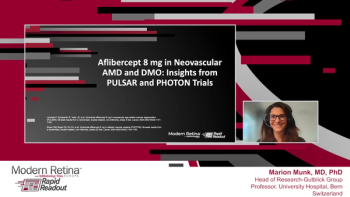
Dr. Marion Munk examines the Phase 2/3 clinical trial of high-dose aflibercept (8 mg) in diabetic macular oedema, presenting key outcomes and clinical implications of the data.
Dr. Marion Munk reviews the Phase 3 clinical trial of high-dose aflibercept (8 mg) in neovascular AMD, emphasizing how this new therapy could alleviate the treatment burden for patients while providing superior outcomes.
Amitha Domalpally, MD, PhD, discusses how disorganization of retinal inner layers affects OCT outcomes in cases of uveitic macular edema.
Philip P. Storey, MD, shares the highlights of his ARVO presentation on a post hoc analysis of the pivotal TENAYA/LUCERNE trials.
Experts conclude the series with the hope that longer-acting agents will lead to better real-world outcomes for patients, mirroring clinical trial results and potentially preventing vision loss, especially in countries with limited access to healthcare.
Experts discusses concerns related to the use of new agents, focusing on intraocular inflammation (IOI) and potential batch variations in biologics faricimab and aflibercept. He emphasizes close monitoring for IOI and advises clinicians to scrutinize patients for any signs of inflammation during follow-up visits.
Peter Kaiser, MD shares his early experiences with faricimab and high dose aflibercept for nAMD and DME. He notes positive outcomes, especially with hard-to-treat patients, and emphasizes the ongoing evaluation of patient response to treatment.
Peter Kaiser, MD discusses the utilization of newer agents, faricimab and high dose aflibercept, for refractory patients who haven't responded well to previous treatments and for patients doing well but aiming to extend dosing intervals.
Experts discuss the use of steroids, particularly in the context of diabetic macular edema (DME). The inflammatory nature of DME reveals the effectiveness of steroids, especially in cases where persistent fluid remains despite anti-VEGF treatment.
David Eichenbaum, MD, FASRS concludes this series with the final case of a treatment-experienced patient switching from aflibercept 2 mg to high-dose aflibercept 8 mg with noticeable improvement after the first dose.
David Eichenbaum, MD, FASRS provides his clinical experience with faricimab and aflibercept 8 mg, highlighting the small and large changes that benefit a patient’s quality of life, such as improved visual anatomy or reducing the frequency of visits.
Experts discuss the approach to loading doses in the context nAMD and DME. Kaiser, MD explains that loading doses may not be necessary based on studies like the CAT study, while he highlights the importance of individualized treatment plans tailored to the specific needs of each patient and the nuances of different retinal diseases.
David Eichenbaum, MD, FASRS discusses his clinical experience in managing retinal fluid, emphasizing the need to dramatically reduce intraretinal fluid, highlighting different strategies of care that offer the best results for patients.
Judy Kim, MD and Peter Kaiser, MD discuss the significance of fluid dynamics in nAMD and DME, highlighting the detrimental effects of fluid fluctuations and emphasize the importance of minimizing these fluctuations to achieve better visual outcomes.