
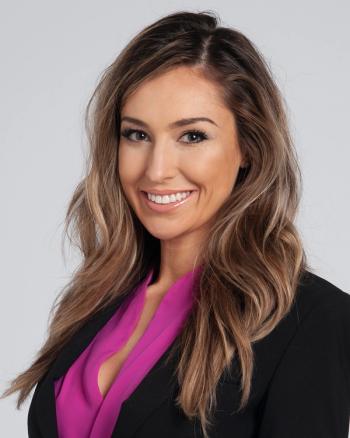
Nicole Bajic, MD, shared a bit about the skills labs at the Women in Ophthalmology Summer Symposium, the value that this meeting provides, and what she is looking forward to at this event.

Nicole Bajic, MD, shared a bit about the skills labs at the Women in Ophthalmology Summer Symposium, the value that this meeting provides, and what she is looking forward to at this event.
Christina Y. Weng, MD, MBA discussed what attendees, both virtually and in-person, can expect from this year's Women in Ophthalmology Summer Symposium meeting in Carlsbad, California. The meeting will take place August 22-25, 2024.
Fasika Woreta, MD, discussed the Roman-Barnes lecture and the cornea care landscape ahead of the National Medical Association meeting.
Consultant ophthalmologist Christiana Dinah, BSc, MB BS, MRes, presented research findings on retinal vein occlusion in the United Kingdom
Alan Franklin, MD, PhD, FASRS, spoke about his presentation, "Intraoperative Fluorescein Angiography Reduces the Rate of Postoperative Vitreous Hemorrhage" at this year's American Society of Retina Specialists (ASRS) meeting in Stockholm, Sweden.
Charles Wykoff, MD, PhD, gives an insight into first-time data from the phase 2, LUNA trial looking at Ixo-Vec at the annual ASRS meeting in Stockholm, Sweden.
Nikoloz Labauri, MD, FVRS, founder of DAVINCI Eye Clinic in Tbilisi, Georgia, discusses his presentation, "Suspensory Macular Buckling for Myopic Traction Maculopathy" at this year's American Society of Retina Specialists (ASRS) meeting in Stockholm, Sweden.
John T. Thompson, MD, spoke about his presentation, "Long-Term Results of Macular Hole Surgery With Long-Acting Gas Tamponade and Internal Limiting Membrane Peeling" at the annual ASRS meeting in Stockholm, Sweden.
Stephen Russell, MD, discussed his presentation on safety and durability of voretigene neparvovec-rzyl for biallelic RPE65 at the annual ASRS meeting in Stockholm, Sweden.
Eleonora Lad, MD, PhD, spoke about her presentation, "Multiwavelength photobiomodulation significantly reduces risk for vision loss and onset of geographic atrophy in dry age-related macular degeneration" at this year's American Society of Retina Specialists (ASRS) meeting in Stockholm, Sweden.
Chase Ludwig, MD, shared an overview of his presentation, which covered real-impact of vitrectomy surgery on the progression of AMD at the annual ASRS meeting in Stockholm, Sweden.
Richard B. Rosen, MD, from the New York Eye and Ear Infirmary of Mount Sinai discussed his presentation on sickle cell retinopathy and the measurement with dynamic OCT angiography and quad-fusion adaptive optics imaging at the annual ASRS meeting in Stockholm, Sweden.
Michael Singer, MD, presented 100-week results from the RESTORE trial and shares key takeaways from his presentation at this year's American Society of Retina Specialists (ASRS) meeting.
Thomas Aaberg, MD, gives an update on Neurotech Pharmaceuticals Encapsulated Cell Therapy platform for the potential treatment of Macular Telangiectasia Type 2, with a projected PDUFA goal date from the FDA at the annual ASRS meeting in Stockholm, Sweden.
Deepak Sambhara, MD, shared an overview of his paper-on-demand, which covered real-world safety and efficacy of aflibercept, 8 mg in the treatment of neovascular age-related macular degeneration at the annual ASRS meeting in Stockholm, Sweden.
Sruthi Arepalli, MD, spoke with Modern Retina about her presentation, "Assessing retinal vascular changes in alzheimer disease with radiomics: A preliminary study of fundus photography" at the annual ASRS meeting in Stockholm, Sweden.
Yasha Modi, MD, spoke with Modern Retina about the ASRS 2024: The DAVIO phase 2 trial and upcoming LUGANO phase 3 trial at the annual ASRS meeting in Stockholm, Sweden.
Jordana Fein, MD, MS, spoke with Modern Retina about the IOP outcomes with aflibercept 8 mg and 2 mg in patients with DME through week 48 of the phase 2/3 PHOTON trial at the annual ASRS meeting in Stockholm, Sweden.
Nathan Steinle, MD, spoke with Modern Retina about the ongoing research on the durability of sozinibercept in combination therapy with anti-VEGF-A treatments at the annual ASRS meeting in Stockholm, Sweden.
Sally S. Ong, MD, spoke with Modern Retina about her research titled, "Individual and neighborhood-level socioeconomic characteristics associated with presenting visual acuity and foveal status in rhegmatogenous retinal detachment" at the annual ASRS meeting in Stockholm, Sweden.
Ashkan Abbey, MD, spoke with Modern Retina about his presentation on the the CALM registry study, the 36-month outcomes of real world patients receiving fluocinolone acetonide 0.18 mg at the annual ASRS meeting in Stockholm, Sweden.
Patrick C. Staropoli, MD, talked about his presentation on the clinical characterization of Hexokinase 1 (HK1) mutations causing autosomal dominant pericentral retinitis pigmentosa at the annual ASRS meeting in Stockholm, Sweden.
Danny Mammo, MD, sat down with Sydney M. Crago, Assistant Managing Editor of Ophthalmology Times and Modern Retina, to discuss the effect of suprachoroidal triamcinolone acetonide in non-infectious uveitis, patients which he is presenting at the American Society of Retina Specialists (ASRS) meeting held in Stockholm, Sweden.
Durga Borkar, MD, MMCi, sat down with Sydney M. Crago, Assistant Managing Editor of Ophthalmology Times and Modern Retina, to discuss Fas inhibition with ONL-1204 for the treatment of geographic atrophy: First-time results from a phase 1b study, which she is presenting at the ASRS meeting held in Stockholm, Sweden.
The final case is presented by Dr Adam, showcasing a 79-year old patient with multiple diagnoses and rapid progression of geographic atrophy.
A second case is examined by Dr Adam, examining a 79-year old diagnosed with cataracts and geographic atrophy.
Dr Adam introduces a patient case for a 70-year old patient being treated with a specific case of geographic atrophy.
Murtaza Adam, MD, opens a discussion surrounding complement therapies for patients diagnosed with geographic atrophy.
Carl C Awh, MD, FASRS, sat down with Hattie Hayes, Editor of Ophthalmology Times Europe, to discuss the first readout of the Phase 3 PAGODA trial at the American Society of Retina Specialists meeting held in Stockholm, Sweden.
Carl J. Danzig, MD, discusses efficacy, safety, and durability of faricimab in macular oedema due to retinal vein occlusion (RVO).