

Nathan Congdon, MD, highlights a recent study showing how virtual mentor-mentee relationships through Orbis' free telemedicine and e-learning platform can significantly enhance care.

Nathan Congdon, MD, highlights a recent study showing how virtual mentor-mentee relationships through Orbis' free telemedicine and e-learning platform can significantly enhance care.

The 2 phase II trials, Osprey and Apteryx successfully met all primary and secondary endpoints.

The 36-week trial was a randomized, double-masked, parallel-group, active-controlled, multicenter evaluating CLS-AX (axitinib injectable suspension) in participants with neovascular age-related macular degeneration.
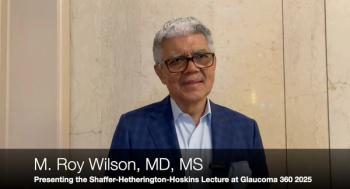
M. Roy Wilson, presented the Shaffer-Hetherington-Hoskins Lecture at the Glaucoma 360 meeting held in San Francisco, California. This lecture was entitled, "Rethinking Race as a Risk Factor for Glaucoma: What Really Matters?"
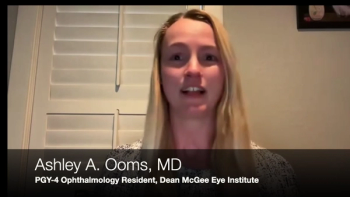
Ooms' poster at the Association of University Professors of Ophthalmology annual meeting highlighted a study on gray area complications in strabismus surgery, showing that trainees are more likely than attendings to disclose these complications despite having similar baseline anxiety levels. Ooms is a PGY-4 ophthalmology resident at the Dean McGee Eye Institute.

Results were published from the phase 3 QUASAR trial and the extension study of the phase 3 PULSAR trial.

The announcement comes after a request was made by the Canadian Investment Regulatory Organization (CIRO) to explore the possibility of a sale.

PRISM evaluates 4D-150, a potential backbone therapy designed to provide multi-year sustained delivery of anti-VEGF (aflibercept and anti-VEGF-C) from the retina with a single, safe, intravitreal injection.
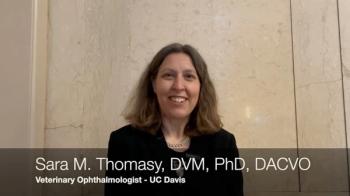
Ophthalmology Times spoke with Sarah M. Thomasy, DVM, PhD, DACVO, a veterinary ophthalmologist at UC Davis about how her research can align with human glaucoma research to move the entire field

The pandemic caused an overall decrease in the rates of the 10 most common ophthalmic procedures performed in 2020 when compared to the year prior.
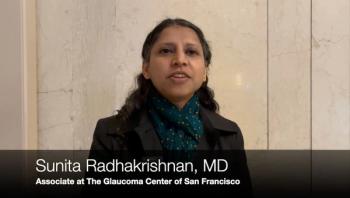
Sunita Radhakrishnan, MD, shares insights on the use of electric neurostimulation and its potential use in the treatment of glaucoma, as evidenced by its current use in Europe and the upcoming trials for use in the US.
Shan Lin, MD, speaks to the new MIGS entering the glaucoma space and providing additional options for patients and providers as they work to preserve vision and work towards a better future for glaucoma treatment options.
Andrew Iwach, MD, co-founder of the Glaucoma 360 meeting shares that value this meeting has for residents and fellows as they embark on their careers and the future additions to the meeting that will include retina discussions.
Inder Paul Singh, MD, speaks to the potential of artificial intelligence (AI) in the management of the glaucoma disease state as well as the current challenges of drug delivery in treating patients with glaucoma.

John Berdahl, MD, discusses a non-surgical, non-drug treatment for glaucoma approved by the FDA in 2024. The pump uses negative pressure to lower eye pressure by an average of 39% in clinical trials, with a good safety profile.
Andrew Iwach, MD, shares how Glaucoma 360 got its start and how today's meeting focuses on innovation that can benefit patients with glaucoma as the condition is monitored and treated.
Sonia H. Yoo, MD, a cornea, cataract, and refractive surgery specialist and a member of the planning committee for the EnVision Summit, highlights a session focused on the latest advancements in lens implant technologies, refractive procedures, and imaging innovations. The summit will be held from February 14 to 17, 2025, at the Caribe Hilton San Juan in Puerto Rico.

Patients commonly reported unexplained blurred or hazy vision postoperatively that requires further investigation

Researchers conducted a study to characterize ophthalmic adverse events associated with cosmetics and personal care products that have been reported in the FDA CAERS database.

From cytokine pathways to genomics, Shree Kurup, MD, highlights new approaches for managing diabetic retinopathy and combating systemic inflammation.

Patients’ near visual needs is important when prescribing medications for glaucoma treatment

This research team evaluated the effectiveness of switching patients to faricimab treatment by assessing their outcomes after 6 months of treatment in a retrospective chart review that included 102 patients with nAMD who had had suboptimal responses to other anti-VEGF therapies.

EssilorLuxottica’s Nuance Audio glasses, which are equipped with hearing aids, will be available over the counter in the US and Europe as soon as Q1 2025.

Real-world scenarios showcase a shift in treatment paradigms

From easing fears to improving mood, a recent study explores how music transforms the surgical experience for both patients and health care teams.
This prospective case-control study included 85 patients with lung involvement related to the COVID-19 virus and a group of 50 healthy controls
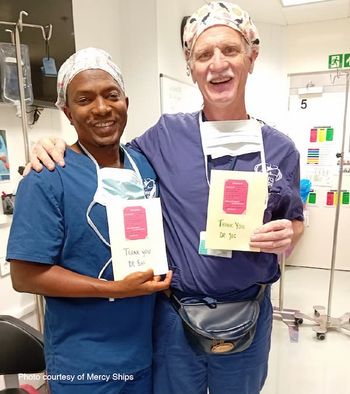
Through its ophthalmic program, Mercy Ships provides critical eye surgeries and trains local professionals, ensuring sustainable eye care for the future.

Susvimo 100 mg/mL for intravitreal use via ocular implant is a refillable implant surgically inserted into the eye during a one-time, outpatient procedure, continuously delivering a customized formulation of ranibizumab over time.

Researchers reported identifying changes in 4 areas of the brain

The company states the acquisition will further MERIT’s service offerings, allowing for a seamless transition from preclinical to clinical phase of drug development.