

The clinical trial will evaluate the safety and efficacy of CLS-AX (axitinib injectable suspension), a tyrosine kinase inhibitor. According to the company, topline data is expected during the third quarter of 2024.

The clinical trial will evaluate the safety and efficacy of CLS-AX (axitinib injectable suspension), a tyrosine kinase inhibitor. According to the company, topline data is expected during the third quarter of 2024.
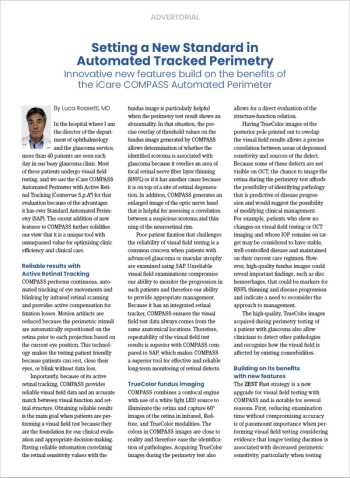
Innovative new features build on the benefits of the iCare COMPASS Automated Perimeter

Prevent Blindness is offering videos, fact sheets, social media graphics and PowerPoint presentations to educate the public on the potential effects diabetes may have on vision.

The collection at the Truhlsen-Marmor Museum of the Eye includes more than 38,000 objects, including rare books, instruments and immersive educational materials.

Researchers have delved into the possibility of cell-based therapy in ophthalmology. By targeting vitreoretinal diseases, they are tackling a range of vision-threatening disorders which often result in severe irreversible vision loss.

According to Genentech, RVO is the third indication for Vabysmo, in addition to wet, or neovascular, age-related macular degeneration and diabetic macular edema. The approval is based on two Phase III studies demonstrating early and sustained vision improvements that were non-inferior to aflibercept.

The issuance provides patent protection in the U.S. for therapeutics incorporating the optimized ELOVL2 transgene until 2041. The patent is being prosecuted in the European Union and other countries around the globe. The company said the patent adds value to its lead program in dry AMD.

According to the company, the software is designed to streamline the flow of information, surgical planning, and enable electronic medical record and diagnostic device integration.

In July 2023, Harrow received certain US and Canadian commercial rights for 6 branded products from Santen.

Several companies including, Kiora Pharmaceuticals, Adverum Biotechnologies, and Aviceda Therapeutics, will share data at the meeting. Our team from Ophthalmology Times will also be in attendance.

This compound will be evaluated for the treatment of geographic atrophy (GA). The company shared that the first-in-human study is set to commence in 2024.

According to a study by a team of scientists led by Duke-NUS Medical School, pursuing fair AI for healthcare requires cross-disciplinary collaboration to translate methods into real-world benefits.

According to the company, AVD-104 is an engineered glycan (sialic acid) nanoparticle designed to target the self-pattern recognition receptors on overly activated retinal immune cells, specifically macrophages and microglia.

These continued studies also demonstrate a well-tolerated safety profile in a broad population of more than 1,200 patients.

The researchers pointed out the eye can be a challenge to sample in living patients as, much like the brain, it is non-regenerative and obtaining a tissue biopsy would cause irreparable damage.

The company continues to turn to experts and leaders to support their mission and the development of new products through these appointments.

This gene therapy is designed to be a one-time intravitreally therapy that has demonstrated potent efficacy and a favorable safety profile in preclinical studies.

The American Academy of Ophthalmology (AAO) 2023 annual meeting is returning home to San Francisco on Friday November 3 through Monday November 6.

This study will evaluate a potential gene therapy treatment in which a targeted gene directly to the retina.

The company made this decision after completing phase 2 trials of the drug.

In the data shared, switching to SB15 from AFL maintained comparable clinical efficacy and safety in treating patients with neovascular age-related macular degeneration (nAMD), confirming biosimilarity between these agents before and after switching.

This effort will advance screening technology at Canada’s foremost specialist care provider in diabetes and endocrinology.

Eclipsing 100,000 doses sold to retinal specialists within the first full year after commercial launch is an important milestone for the company.

In the wake of the October 7 surprise attack by Hamas, Israel finds itself thrust into war, and ophthalmologists are working to provide the best care they can under the conditions they find themselves in.
Phase 2/3 SIGLEC trial are underway. Data shared at EURETINA 2023 shows continued safety with no drug-related adverse events thus far in cohorts 1, 2, 3, and 4.

Nathan Steinle, MD, spoke with Modern Retina's editor to give insights into his Retina Society presentation titled, "Phase 3 studies of dual inhibition of VEGF C/D and VEGF A using OPT-302 in combination With ranibizumab (ShORe Trial) or aflibercept (COAST Trial) in neovascular AMD."

At the 56th annual Retina Society congress in New York, David Boyer, MD, gave a presentation titled, "Subgroup analyses of phase 1 DAVIO Trial of EYP-1901 demonstrating reduced treatment burden in wet age-related macular degeneration."

Sophie Bakri, MD, MBA, shared insights from her presentation, "Comparison of the Antiangiogenic Profile of Tyrosine Kinase Inhibitors Vorolanib, Axitinib, and Sunitinib."

Researchers note their work reports a novel candidate gene for FEVR, which expands the spectrum of EMC1 variants and EMC1-related phenotypes, providing evidence for the prenatal diagnosis of candidate disease-causing EMC1 variants in FEVR.

The patent covers the company’s development of this cell transplant therapy as a treatment for geographic atrophy.