
Carl C Awh, MD, FASRS, sat down with Hattie Hayes, Editor of Ophthalmology Times Europe, to discuss the first readout of the Phase 3 PAGODA trial at the American Society of Retina Specialists meeting held in Stockholm, Sweden.

Carl C Awh, MD, FASRS, sat down with Hattie Hayes, Editor of Ophthalmology Times Europe, to discuss the first readout of the Phase 3 PAGODA trial at the American Society of Retina Specialists meeting held in Stockholm, Sweden.
Rishi P. Singh, MD, sat down with Sydney Crago, Assistant Managing Editor of Modern Retina, to discuss his presentation on the results from part 1 of the Phase 2/3 SIGLEC trial assessing AVD-104 for GA at the American Society of Retina Specialists meeting held in Stockholm, Sweden.
Theodore Leng, MD, MS, sat down to discuss his presentation on the FARETINA-DME Study at the American Society of Retina Specialists meeting held in Stockholm, Sweden.
Carl J. Danzig, MD, discusses efficacy, safety, and durability of faricimab in macular oedema due to retinal vein occlusion (RVO).
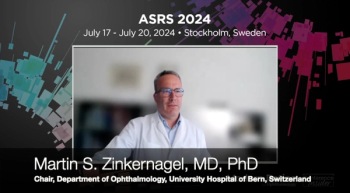
Martin Zinkernagel, MD, PhD, sat down with Hattie Hayes, Editor of Ophthalmology Times Europe, to discuss his time on the sustainability expert panel Study at the American Society of Retina Specialists meeting held in Stockholm, Sweden.
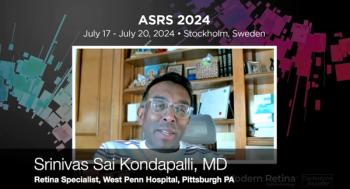
Srinivas Sai Kondapalli, MD, sat down with Sydney M. Crago, Assistant Managing Editor of Ophthalmology Times and Modern Retina, to discuss outer retinal tubulations in lesion growth for subfoveal and non-subfoveal GA.

Adverum CEO Laurent Fischer spoke exclusively to Modern Retina about the 26-week interim analysis.

The drug performed well in the various subgroup analyses of patients with and without previous treatment for diabetic macular edema (DME).
Sydney M. Crago, Assistant Managing Editor of Ophthalmology Times and Modern Retina, spoke with attendees, who shared which topics they are most looking forward to discussing at the ASRS meeting held in Stockholm, Sweden.
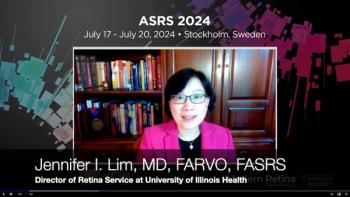
Jennifer I. Lim, MD, FARVO, FASRS, sat down with Sydney M. Crago, Assistant Managing Editor of Ophthalmology Times and Modern Retina, to discuss her ASRS 2024 presentation, "Differential Artery-Vein Analysis Improves OCTA Performance for Artificial Intelligence Classification of Diabetic Retinopathy."

The key factor may be the control of inflammation.

EyeBio is developing a pipeline of clinical and preclinical candidates for the prevention and treatment of vision loss associated with retinal vascular leakage.

This marks 21 years in a row the hospital has been top-ranked by the US News & World Report in the field of ophthalmology.

Researchers from the UKB Eye Clinic, in cooperation with the University of Bonn and in close collaboration with basic and clinical scientists, have examined patients with early forms of AMD. The researchers focused on the so-called iRORA lesions, which are very early anatomical signs of retinal damage.

Researchers, led by Shigemi Matsuyama, PhD, will conduct research seeking a potential breakthrough drug that can be taken orally—one that may address many RP disease manifestations, regardless of the underlying genetic mutation.

AAV204 is a novel adeno-associated virus (AAV) capsid from the AIM capsid library licensed by Abeona from the University of North Carolina at Chapel Hill.

The companies are teaming up to reduce care gaps and improve eye and vision health by bringing diabetic retinopathy and other eye disease screening services to patients in their own homes and workplaces.

The organization has secured £72.75 million for its new eye health center.

Companies continue to share news about the data that will be presented at the 2024 ASRS meeting in Stockholm, Sweden.

A novel formulation may prevent blood vessel growth and vascular leakage in the retina.

Ophthalmologist receives the Roger Steinert, MD, Legacy Award during the Octane Ophthalmology Tech Forum in Irvine, California.
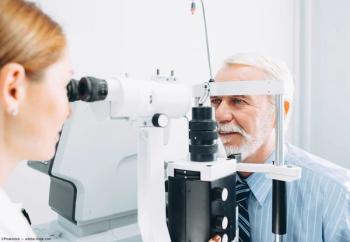
A team of researchers at the Ohio State University found that in mice an enzyme related to cell growth and division is a culprit in the blood vessel invasion in the back of the eye that causes blurred central vision in wet AMD.

The company announced it has received FDA approval to relaunch Susvimo for intravitreal use via an ocular implant for treating people with wet AMD.
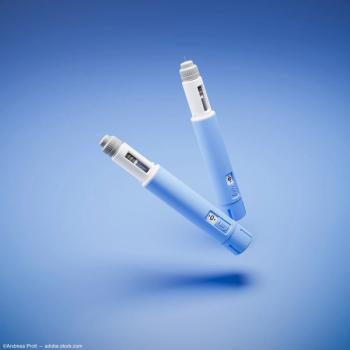
Prescriptions with semaglutide (Wegovy, Ozempic, Novo Nordisk) are FDA approved to treat obesity and type 2 diabetes, respectively.

The funding will go toward the continued clinical development of the company’s lead asset, AGTC-501 (laruparetigene zovaparvovec)

The pharmaceutical candidate is being evaluated as a potential treat for nAMD.

42nd Annual Meeting in Stockholm, the Venice of the North

According to Genentech, faricimab-svoa is the first and only syringe prefilled with an FDA-approved bispecific antibody for the treatment of wet AMD, DME and RVO.

The deal included a total upfront consideration of $81 million, including a cash payment of approximately $65 million.

Apellis plans to seek re-examination, with a final opinion expected in fourth quarter of 2024.