
ALG-1001 is an integrin receptor inhibitor that acts to stabilize the retina’s response to diabetes-related hypoxic and oxidative stress, mitigating production of a host of molecules involved in the development of diabetic macular edema.

ALG-1001 is an integrin receptor inhibitor that acts to stabilize the retina’s response to diabetes-related hypoxic and oxidative stress, mitigating production of a host of molecules involved in the development of diabetic macular edema.


Take-Home Message: A pearl for preventing endophthalmitis following intravitreal injections: avoid eyelid contact with the injection site after the last application of povidone iodine.


Brimonidine Drug Delivery System (Brimo DDS) in an intravitreally administered, sustained-release implant (Allergan) shows promise as a treatment for geographic atrophy (GA), secondary to age-related macular degeneration in a phase IIa clinical trial.

Topline results from phase III studies investigating intravitreal brolucizumab (Novartis) for treatment of neovascular age-related macular degeneration (nAMD) support the potential of this novel anti-VEGF antibody to meet the real-world need for an alternative agent with a sustainable therapeutic regimen.

Take-Home Message: The Telescopic Intra-Ocular Lens for Visually Impaired People Revolution system is promising to improve the vision in patients with maculopathies.

Take-Home Message: YAG laser vitreolysis might be a treatment option for patients with complaints of floaters. Larger studies of longer duration are needed to corroborate these results.

ALG-1001 (Luminate, Allegro Ophthalmics) has a number of different mechanisms of action that benefit patients chronically treated with anti-vascular endothelial growth factor drugs and those who are treatment naïve.

Patients with diabetic retinopathy have a high risk of developing macular edema after cataract surgery. Intravitreal injections of aflibercept might result in fewer patients developing macular edema in this patient population.

Adaptive optics (AO) is providing new insights about retinal structure and may help to identify potential areas for treatment of retinal diseases, said Mina Chung, MD.

There is no doubt that inflammation is a component of age-related macular degeneration (AMD), and yet the role of corticosteroid treatment in the management of eyes with AMD remains uncertain, said Marc de Smet, MD, PhD.

A new high-density OCT angiography system (AngioVueHD, OptoVue) provides exquisite views of the retinal microvasculature without the need for injection of fluorescein dye.

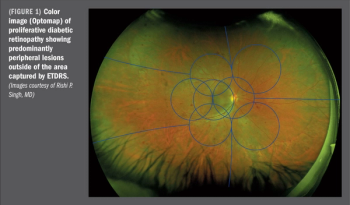
Ultra-widefield imaging has become an important component of a thorough eye exam and is taking on a larger role in retina and comprehensive ophthalmology.

A recently released ultra-widefield fundus camera takes images in true color and captures high-resolution imagess rom the macula to the far periphery.

Study results provide new information about the risk and strategies for preventing tractional retinal detachment (TRD) development or progression in eyes with severe proliferative diabetic retinopathy (PDR) receiving intravitreal bevacizumab (Avastin, Genentech) prior to vitrectomy.

Modern 27-gauge equipment for vitrectomy has introduced a new paradigm in vitreoretinal surgery marked by enhanced precision and control.

Temporary scleral buckling performed with a removable external device provides the benefits of scleral buckling while addressing its downsides as surgery for a detached retina.

Glucose entrapment in the retinal pigment epithelium is responsible for central vision loss in retinitis pigmentosa. Injecting wild-type rods into the eye to restore glucose transportation or injecting glucose into the subretinal space can facilitate cone regeneration.

Achieving the best visual outcomes in challenging cases is a high priority in surgical retina. However, meeting that goal involves a high level of creativity, especially in complex cases associated with other ocular comorbidities.

Intraoperative optical coherence tomography (OCT) is becoming widely available, and its adoption is increasing, but improvements in the technology are needed to maximize its readiness for prime time, according to Justis P. Ehlers, MD.

Macular hole surgery can be performed using various techniques and technologies. According to John T. Thompson, MD, the available evidence supports always incorporating internal limiting membrane (ILM) peeling, staining of the ILM, and having a large gas bubble in the eye on the first postoperative day.

Suprachorodial hemorrhage can be managed effectively with a conservative approach, but if surgical intervention becomes necessary, timing is critical for optimizing the outcome and minimally invasive techniques can be considered, said John W. Kitchens, MD.

Anti-vascular endothelial growth factor (VEGF) therapy is highly successful, but as Raj Maturi, MD, pointed out, also has some limitations.

Another adverse effect associated with the compounding process of bevacizumab (Avastin, Genentech)-i.e., the presence of silicone oil droplets in the vitreous cavity-has surfaced within the past year and seems to be related to the preloading of the drug in insulin syringes.

Subretinal hyperreflective material (SHRM) is a morphologic component seen on optical coherence tomography (OCT) images as hyperreflective material that is external to the retina and internal to the retinal pigment epithelium (RPE), said Jaya B. Kumar, MD.

Carol. L. Shields, MD, highlighted the results of collaborative efforts among four Philadelphia institutions: Wills Eye Hospital, Thomas Jefferson Hospital, the Genetics Department of the University of Pennsylvania, and the Wistar Instituate. The findings were published in Ophthalmology (Shields et al. 2017; published online May 7, 2017).

A surgical innovation is defined as a quantum improvement in the treatment of a particular disease or group of diseases, and it usually is developed by an individual or a small group working together, said John Thompson, MD.