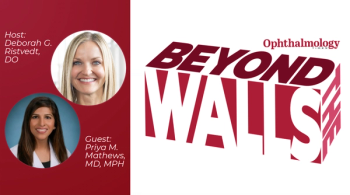
Host Deborah Ristvedt, DO, welcomes Dr. Mathews to discuss the relationships, passions, and intentional choices that have shaped her career as a cornea, cataract, and refractive surgeon, dry eye expert, and educator.

In the latest episode of The Wills Retina Report, Dr. Regillo and Dr. Hsu discuss why sustained delivery with the port delivery system may outperform even closely monitored intermittent injections.
Although the port delivery system with ranibizumab (Susvimo; Genentech, a member of the Roche Group) has been available for several years, achieving broad utilization in retina practice remains an evolving conversation. In this episode of The Wills Retina Report with Regillo and Garg from
Despite what Regillo called impressive real-world performance, "in practice, though, we're not seeing a lot of utilization," he said, asking Hsu to weigh in on why.
Hsu pointed to newer anti-VEGF agents and angiopoietin-2 combination therapies, which are extending injection intervals to 4 to 6 months and narrowing the durability advantage that once set the port delivery system apart. Many patients, when offered the device, tell Hsu they do not mind their current injection schedule and remain reluctant to undergo surgery, even those who need frequent treatment. Lingering awareness of the 1.6% endophthalmitis rate reported in the original ARCHWAY trial (NCT03677934) has also made some clinicians and patients cautious, he noted, even as more recent data show substantially improved safety outcomes.
Rates of endophthalmitis and conjunctival complications have declined substantially since the device’s early clinical trials, Hsu said. A major revision to the surgical protocol in 2020, emphasizing meticulous 2-layer conjunctival and Tenon’s closure, brought the overall complication rate to approximately 1% across all implants and disease states.
Patient age also appears to influence outcomes, according to Hsu, since younger patients tend to have thicker conjunctival tissue that may be easier to work with during implantation. He noted that the diabetic retinopathy trials PAGODA (NCT04108156) and PAVILION (NCT04503551), which enrolled younger patients with a mean age of approximately 50 to 60 years, recorded only 1 case of endophthalmitis in PAGODA and none in PAVILION.
A post hoc analysis of the PAGODA trial, conducted with Genentech, compared outcomes in patients with bilateral diabetic macular edema who received the port delivery system in 1 eye while their fellow eye was treated with anti-VEGF injections as needed. More than half of the device-treated eyes had no intraretinal fluid at the 2-year mark, and twice as many showed no leakage at all, compared with fellow eyes, which showed persistently higher rates of leakage, thickening, and worsening severity scores.
"[That] really just underlines the fact that even though those patients were being monitored monthly, that we do tend to under-treat as physicians," Hsu said, adding that the device provides consistent VEGF suppression without requiring ongoing treatment decisions at each visit.
"Sustained delivery works better than even seeing the patients frequently and injecting with our current biologics," Regillo added.
Beyond reducing treatment burden, Hsu described the port delivery system as a safeguard for patients who may otherwise miss treatment, whether due to hospitalization, weather, or other disruptions to follow-up care—an issue he has studied extensively in the context of loss to follow-up with intravitreal injections. “This is really kind of like a safety net for them in many ways,” he said.
Regillo pointed to long-term extension study data from the phase 3 Portal trial (NCT03683251) showing maintained visual acuity and few late complications over 5 to 7 years, calling the device’s proof of concept well established.
Carl D. Regillo, MD, FASRS
E:
Jason Hsu, MD
Regillo and Hsu disclose consulting and research grant support from Genentech/Roche.
Genentech, a member of the Roche Group, was not involved in the content of this podcast.