


Commentary|Podcasts|January 8, 2026
iOpeners with Nicole Bajic, MD: Mary Qiu, MD, on tailored NVG pathways
Author(s)Nicole Bajic, MD, Mary Qiu, MD
Fact checked by: Sheryl Stevenson

Their conversation focuses on anatomy-driven, individualized approaches and multidisciplinary decision-making for patients with neovascular glaucoma.
Advertisement
Episodes in this series





With January being Glaucoma Awareness Month, it seems fitting to discuss neovascular
Stratifying NVG management by angle anatomy
Qiu describes how her management philosophy evolved from residency—where NVG patients often went straight to urgent Ahmed tube shunt surgery—to a more tailored approach she learned during fellowship at Cleveland Clinic and has applied over the past 5 years at the University of Chicago. Central to this strategy is careful gonioscopy at presentation.
As she explains, “this angle anatomy at the time of presentation is really critical to helping us decide what to do next.”
Open-angle vs closed-angle NVG: Divergent treatment pathways
For patients who present with NVG but retain an open angle, Qiu notes that anti-VEGF therapy, an anterior chamber tap if needed, and maximal glaucoma medications can often successfully lower intraocular pressure. In these cases, pressure may normalize without emergent tube surgery. This allows time for close follow-up and, if necessary later, consideration of angle-based procedures such as goniotomy. She notes that these cases require close coordination with retina specialists to ensure that neovascularization remains suppressed and the angle remains functional.
In contrast, eyes presenting with total synechial angle closure represent, in Qiu’s words, “a completely different workflow.” For these patients, she favors urgent primary cyclophotocoagulation to immediately reduce aqueous production and lower pressure without the added bleeding risk of incisional surgery. Anti-VEGF therapy is administered concurrently so the eye is stabilized while waiting for neovascular regression.
Collaborative glaucoma and retina care in NV
Once the eye is quieter and pressure control stabilizes, tube surgery can be performed later in a more controlled, elective setting. Qiu explains that this staged approach allows surgeons to avoid emergent valve placement and instead consider non-valved tubes with better long-term outcomes. Reviewing outcomes at the University of Chicago, she notes that many eyes with open angles were able to avoid tube surgery entirely. She refers to these cases as “salvaging their angle,” reducing exposure to long-term tube-related complications.
Qiu also discusses a selective role for trabeculectomy in quiescent NVG, particularly in settings where tube shunts are not available, again underscoring that sustained collaboration with retina colleagues is essential. She notes, NVG is “a really complex, multidisciplinary illness,” and success depends on individualized, anatomy-driven decision-making and long-term retinal disease control.
Readers may direct their NVG-related questions to Qiu at mary.qiu@gmail.com .
Advertisement
Related to this article

Their conversation covers a holistic, cross-specialty approach to ocular surface disease and the unmet need driving a new model of dry eye care in Ireland.
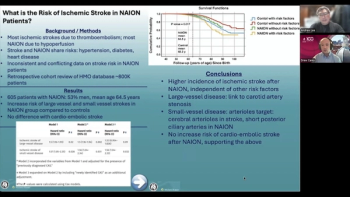
Andrew G. Lee, MD, and Drew Carey, MD, discuss findings from a retrospective study examining ischemic stroke risk in patients with non-arteritic anterior ischemic optic neuropathy and the implications for vascular risk factor management.

Offline smartphone AI fundus screening detects diabetic retinopathy, glaucoma, and macular degeneration in one capture, delivering high accuracy for low-resource eye care.

A large real-world cohort study finds OSA is associated with elevated glaucoma risk, though whether positive airway pressure therapy itself plays a role remains unclear.

Bayer acquired Perfuse Therapeutics and its experimental endothelin-blocking eye implant PER-001, and partnered with AI firm Iambic Therapeutics to accelerate small molecule drug discovery.

A retrospective study finds that direct selective laser trabeculoplasty significantly lowers intraocular pressure, with the greatest benefit seen in treatment-naive eyes.

Douglas D. Koch, MD, and Karolinne Maia Rocha, MD, PhD, discuss the optics behind enhanced monofocal lenses, patient selection, and how to set expectations.

In this Q&A, Ping Moore, OD, covers emerging dry eye therapies, from selenium sulfide to next-gen cyclosporine, and how subtype-guided care shapes treatment choices.
Advertisement
Advertisement
Trending on Eye Care Network - Ophthalmology Times
1
Brepocitinib meets all Phase 3 end points in noninfectious uveitis
2
Myopia control using spectacle lenses with highly aspherical lenslets
3
Demodex blepharitis: Diagnosis, treatment response, and recurrence
4
CHMP recommends ranibizumab biosimilar Fovlussea for retinal disease
5