

News
Advertisement

Lineage Cell Therapeutics will be presenting data on the safety and tolerability of RG6501 (OpRegen) for the treatment of geographic atrophy, secondary to age-related macular degeneration during the upcoming Clinical Trials at the Summit 2025 meeting.
Advertisement

Recent study data reveal a significant rise in childhood astigmatism linked to the COVID-19 pandemic, independent of myopia.

Ophthalmologist Tarek Hassan introduces new surgical approach for proliferative vitreoretinopathy, using precise small retinotomies instead of extensive retinal removal to improve patient outcomes.

The study found an increase in both refractive astigmatism and corneal astigmatism among a patient population of schoolchildren

At ARVO 2025, in Salt Lake City, Utah, Viha Vig, talked about her poster presentation investigating the relationship between ocular and systemic mitochondrial diseases and dementia
Advertisement

Ultra-wide field imaging shows nonperfusion and leakage independently predict diabetic retinopathy progression, suggesting earlier treatment with anti-VEGF or photocoagulation may prevent complications.

Kriya Therapeutics presented preclinical data on its gene therapy candidate for the treatment of geographic atrophy.

Three dose level cohorts of the small interfering RNA therapeutic were evaluated in a double-blind study

Ashvattha Therapeutics reveals promising phase 2 results for migaldendranib, showcasing significant improvements in retinal disease treatment and reduced injection burden.
Advertisement

Ashvattha Therapeutics announced positive interim phase 2 results for migaldendranib for the treatment of AMD and DME.

Financing will fund phase 1b trials evaluating its lead candidate, THN391, for the treatment of Alzheimer disease and diabetic macular edema (DME).

SYL1801 is an investigational siRNA therapy administered via eye drops, rather than intravitreal injection, to treat nAMD.
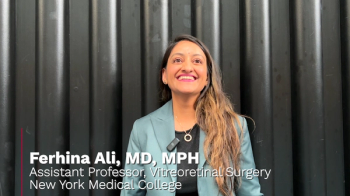
At ARVO 2025, in Salt Lake City, Utah, Ferhina Ali, MD, MPH, talked about her presentation on the early real-world use of aflibercept 8 mg in treatment-naive patients with neovascular age-related macular degeneration

Four-year study shows faricimab in treat-and-extend regimen maintains vision for diabetic macular edema patients with significantly fewer injections over time.

By making these retinal pigment epithelium (RPE) cells visible, researchers have created implications for early detection of disease and the monitoring of treatment response.

Shifting from a regulatory role to driving innovation directly, Eydelman discusses how the Collaborative Community on Ophthalmic Innovation is reshaping the field, streamlining outdated processes, and advancing patient-centered solutions worldwide.


At ARVO 2025, in Salt Lake City, Utah, C Michael Samson, MD, MBA, gave insight into his data on immune cell profiling in birdshot retinochoroidopathy using single-cell RNA sequencing.

The bill, which passed on May 1, allows for West Virginian ODs to provide certain in-office procedures such as laser treatments

SYL1801 is a treatment for neovascular macular degeneration administered via eye drops.

A machine learning model incorporating treated astigmatism and nuanced inputs is advancing the precision and personalization of arcuate keratotomy planning

Rishi Singh, MD, discusses faricimab's real-world effectiveness in treating diabetic macular edema, highlighting improved vision and reduced treatment frequency.

AAVantgarde Bio reveals promising safety and efficacy data for AAV-based therapies targeting Usher syndrome and Stargardt disease at ARVO 2025.


LumiThera's Valeda system offers groundbreaking non-invasive treatment for dry AMD, showing extended vision improvement and safety over 4.5 years.


Investigators sought to understand the diagnostic path, symptoms, quality of life impact and coping mechanisms of patients with GA in western Europe and the United States

Kapil Mishra, MD, discusses an overview of radiation retinopathy and its challenges in treating uveal melanoma from his presentation "Radiation Retinopathy: Future Strategies,"

NCX 470, Nicox’s lead clinical product candidate, is a novel NO-donating bimatoprost eye drop with a dual mechanism of action (nitric oxide and prostaglandin analogue).
Advertisement
Advertisement