

News
Advertisement
Advertisement
An analysis of data from the Intelligent Research in Sight (IRIS) Registry provides insights about real-world success rates for primary repair of retinal detachments, said Richard S. Kaiser, MD.
An intravitreal injection device can provide repeatable results and added comfort for the patient, removing the need for a drape and speculum.
Compared with intravitreous ranibizumab, the decreases in the plasma-free VEGF levels were greater with intravitreous aflibercept and bevacizumab in patients with diabetic macular edema.
Most commercially available OCT and OCTA devices can provide widefield OCTA through a combination of faster speeds, tracking, and the ability to montage images. This may revolutionize clinicians’ ability to assess and quantify retinal vascular disease.
Advertisement
Two patients with macular degeneration regained reading vision after receiving stem cells implanted with a new technique, according to researchers.
Although the phase III Chroma and Spectri studies for lampalizumab (Genentech), an investigational compound for the treatment of geographic atrophy secondary to age-related macular degeneration (AMD), failed to meet their primary endpoints, numerous lessons can be learned from the study data.

With the first ocular gene therapy approved in the United States, Szilard Kiss, MD, points out that the gene therapy era for retinal disease has arrived, “and hopefully it will arrive for age-related macular degeneration.”
Among a subset of patients in the phase IV PALADIN study, there was improved visual acuity, improved macular thickness, and reduced treatment burden among patients treated with the intravitreal fluocinolone acetonide 0.2 µg (Iluvien implant) for DME.
Advertisement
The addition of dexamethasone implant (Ozurdex, Allergan) to a continuing regimen of ranibizumab (Lucentis, Genentech) did not produce results in visual acuity outcomes that differed from those achieved with ranibizumab alone at 6 months. However, there was an improvement in the central macular thickness on OCT in patients.
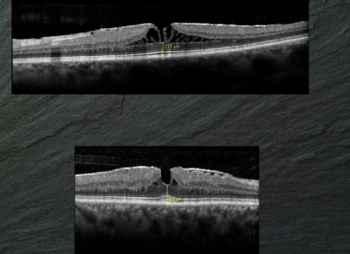
Lamellar holes usually don’t require treatment, but it is important to recognize the eyes that may benefit from vitrectomy.

Using ultrasonic power to actuate a vitrectomy probe (hypersonic vitrectomy) allows for a “smooth steady flow of vitreous into a port that is oscillating at 1.7 million cycles per minute,” according to Carl C. Awh, MD.
The use of aflibercept led to greater improvement in macular perfusion status in a phase III trial with DME patients. Those with baseline nonperfusion tended to have more advanced disease.
Clinical trial data focusing on treatment for age-related macular degeneration (AMD) have been a highlight at many recent ophthalmology meetings. Here are a few of the latest clinical trials that physicians need to be aware.
Although a proven treatment therapy, age-related macular degeneration (AMD) requires frequent, costly anti-vascular endothelial growth factor (anti-VEGF) injections. Some pharmaceutical companies do have patient-assistance programs to help alleviate the financial burden.
Preliminary research has shown that ataluren is effective in overriding the nonsense mutation in choroideremia patients, however, further research is needed.
A study has revealed that a budgetary saving per treated patient with the fluocinolone acetonide implant (Iluvien) versus ranibizumab (Lucentis) could lead to a significant cost-saving to NHS England.
Twelve-month results of the FILLY trial show that in patients with geographic atrophy, the administration of complement C3 inhibitor APL-2 slowed the growth rate of the disease. It also appeared to increase the risk of new onset AMD, although this did not have an adverse effect on visual outcomes.
A retinectomy performed under air using a sequenced approach can improve outcomes.

Research on treatments and/or causes of age-related macular degeneration (AMD) covers a wide range of approaches and paradigms. The latest research published in the past three months are perfect examples for understanding and treating AMD.
Age-related macular degeneration (AMD) is the leading cause of significant visual acuity loss in people over the age of 50 in developed countries. Almost 80% of the people diagnosed with AMD will have the non-neovascular (dry) or atrophic subtypes. Here is the clinical information patients need to understand this disease.
There is subset of patients with resistant or persistent DME that forms the impetus for new treatment strategies, including next-generation anti-VEGF-A and new classes of drugs. Pravin U. Dugel, MD, outlines a list of potential treatment candidates that may lead that paradigm shift.
Two of the top 10 “most-talked-about” articles in JAMA Ophthalmology are about age-related macular degeneration (AMD). One of the current top 5 “most-read” articles in the American Journal of Ophthalmology is also about AMD. Here are a brief synopsis of those three papers.
The American Academy of Ophthalmology’s Preferred Practice Pattern on Age-Related Macular Degeneration “are based on the best available scientific data as interpreted by panels of knowledgeable health professionals.” These patterns offer solid clinical guidelines for treating and counseling AMD patients.
In patients with age-related macular degeneration managed by a treat-and-extend regimen, the visual acuity generally was maintained; lesion reactivation occurred frequently at about eight weeks; and longer induction phases between treatments was associated with worse outcomes.
Voretigene neparvovec-rzyl (Luxturna, Spark Therapeutics) was approved in December 2017 for the treatment of patients with confirmed biallelic RPE65 mutation-associated retinal dystrophy. Clinical trial results and patient selection issues for this gene therapy are discussed.
A well-known dilemma surrounding AMD is that there lacks a universally accepted treatment regimen with anti-VEGF injections. The balance between optimal visual outcomes and treatment burden has led some specialists to embrace the treat-and-extend regimen over monthly treatments.
Since February is designated Age-Related Macular Degeneration Awareness month. For healthcare providers, there are numerous resources available to help promote awareness to patients and to encourage patients to continue (or start) annual visual exams.
Sixteen fellows and residents show just why research in retina is on the cutting edge
Advertisement
Advertisement
Trending on Eye Care Network - Ophthalmology Times
1
2026 Nobel Prize in Physiology or Medicine awarded for optogenetics discovery
2
Oku Digital Health launches from Topcon to link eye care, primary care
3
EURETINA 2026: Optogenetic therapy MCO-010 aims to restore vision in advanced macular disease
4
EURETINA 2026: Eyestem interim Phase 2 results for clinical study of Eyecyte-RPE for GA secondary to dry AMD
5