

Clinical Forums
An experienced clinician discusses the challenges of identifying and managing a common yet often overlooked eyelid condition. She emphasizes a systematic approach to diagnosis, the importance of differentiating it from other ocular surface diseases, and how emerging therapies can transform patient care. Through practical insights and case examples, she demonstrates how accurate detection and targeted treatment can dramatically improve comfort, vision, and quality of life for patients struggling with chronic irritation and inflammation.

Mark Lobanoff, MD, discusses how the IC-8 Apthera small aperture intraocular lens functions as a pinhole-based optical system to create extended depth of focus, demonstrates successful salvage of a complicated light adjustable lens case through lens exchange after pinhole testing, and emphasizes the critical importance of controlling central 3-mm zone astigmatism and ensuring nighttime pupil size remains under 5 mm for optimal visual outcomes in keratoconus patients requiring adjunctive photorefractive keratectomy.

Panelists discuss how interventional glaucoma strategies, sustained-release drug delivery implants, and the versatile iDose device advance care by enabling earlier treatment, improving adherence, and expanding surgical options for long-term disease control.

Sahar Bedrood, MD, PhD, discusses how glaucoma treatment has evolved from a reactive wait-and-see approach to a more proactive strategy that emphasizes early procedural interventions such as sustained-release implants and minimally invasive surgeries to minimize medication burden and vision loss.
Michael W. Stewart, MD, discusses how high-dose aflibercept (8 mg) can achieve better anatomical and visual outcomes compared with standard anti-VEGF therapies in patients with treatment-resistant diabetic macular edema and neovascular age-related macular degeneration, demonstrating improved retinal drying and extended treatment durability through 3 detailed clinical cases.
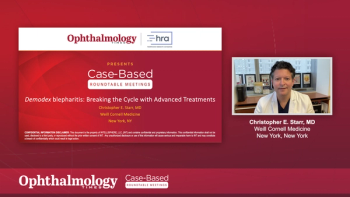
Christopher E. Starr, MD, discusses how to identify, diagnose, and effectively treat Demodex blepharitis in both preoperative cataract patients and contact lens wearers, highlighting the importance of eradicating these mites using FDA-approved lotilaner ophthalmic solution to improve visual outcomes and quality of life.

An expert discusses how innovative viscoelastic delivery systems are enhancing precision, control, and safety in ophthalmic surgery by improving anterior chamber stability, protecting intraocular structures, and optimizing surgical outcomes.
Steven J. Dell, MD discusses how managing cataract surgery in post-refractive surgery patients presents unique challenges including accurate IOL power calculation, epithelial healing variability, and the need for specialized approaches such as piggyback IOLs and careful lens selection to meet high patient expectations for spectacle independence.

Nikolas JS London, MD, FACS presents two cases, one with a 92-year-old woman with a long history of bilateral nAMD, and one with a 70-year-old man with IDDM.
Talia R. Kaden, MD, presents multiple patient cases including a case of choroidal neovascularization with polypoidal choroidal vasculopathy, diabetic macular edema, recurrent retinal vein occlusion, and neovascular age-related macular degeneration with persistent subretinal fluid.
Kamran Riaz, MD, presents an overview of enhanced monofocal IOLs and discusses special cases where they could be considered in addition to conventional cataract surgery.
Albert S. Khouri, MD, describes two patient cases with different stages of glaucoma and discusses interventional treatment options, including selective laser trabeculoplasty and various MIGS devices.
Richard Adler, MD, FACS, reviews thought-provoking patient cases to showcase how the diagnosis and management of dry eye disease can be improved.
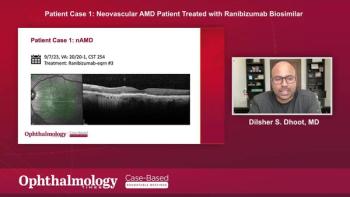
Dilsher S. Dhoot, MD shares his experience leading a case-based roundtable discussion on anti-VEGF biosimilars for retinal diseases, highlighting key insights from each patient case.
Dr Dilsher Dhoot shares his experience of using anti-VEGF biosimilars for managing retinal diseases and presents two patient cases where he achieved significant anatomic improvement by using a ranibizumab biosimilar.
Advertisement
Advertisement